Showing posts with label First World War. Show all posts
Wednesday, 7 February 2018
THE GOOSE ROAD by Rowena House. A review by Adèle Geras
I'm a very dutiful reader. I feel that if the writer of a novel wanted me to know something BEFORE I read her book, she'd have put it in a note at the front. Rowena House has put her historical note at the back of the book, with the result that it came as a wonderful surprise to find out about the things that led her to write this story, which is published in April. The image above is from the bound proof which I read.
This year marks a century since the Armistice after the War to End All Wars. It hasn't turned out to be a peaceful century, of course, but this book takes a part of the world (Northern France) and a very well-documented and written-about conflict and tells the kind of story we haven't often seen in this context.
It's mainly a story about a family and about a way of life. The Lacroix family have a farm called La Mordue and Angélique finds herself, right at the beginning, facing the death of her father in the War. This, because of the kind of man he was, she regards as something of a blessing. He was cruel and abusive to her, to her mother and to her brother, Pascal, who is also away at the war.
Because of what emerges about her father after his death, and because the bailiffs are about repossess the farm, Angelique takes her beloved flock of geese, (including her special favourite, Amandine and the formidable gander, Napoleon Bonaparte) and begins a journey through the war-scarred countryside to sell them to Marshall Foch in order to get enough money to save the family farm. Things, naturally, do not go according to plan and her adventures form the greater part of the story.
The book takes the form of a quest. Angélique is looking for money but finds many other things along the way. Most importantly, she meets Uncle Gustav and he takes her to his own home, to meet again a person she'd previously misjudged, her Aunt Mathilde.
Angélique, like all heroines of novels involving a journey, learns much along the way. She loves a young man called René and is convinced that both he and her dear brother Pascal are safe and sound, in spite of all the carnage. She learns about what war can do to a man, even one who doesn't have half his face shot away. And she learns that cruelty and abuse is something that gets handed down through the generations. I won't spoil anyone's pleasure by detailing her adventures, but there are many incidental pleasures to point out.
One of the things I enjoyed most was the description of the geese. It's an irony, I suppose, that Angelique is fully intending these geese to be eaten even though she loves them so much, but she's practical as well as a dreamer and that's how things are. Geese are for food. Still, the reader gets to love the creatures too and we're sad as readers when any of them dies.
There's also a good description of the way war carves out horrors on a quiet town and its inhabitants. Descriptions of wounded and damaged men abound. The war is not only on the battlefields, not only in the sounds of mortar and shell but also in the howls of sorrow and pain coming from the civilian population and those who've escaped from the fray into a lifetime of being haunted by what they witnessed as they fought.
The story is simply told, in the present tense for the most part and one of the good things about it is the young female perspective of our heroine. Who really does turn out to be a heroine....
I hope that everyone who reads it enjoys it as much as I did. I think it would make a very good addition to the library of any class studying this period in our history.
And when you do get to the end, you'll be as interested as I was to read about the inspiration behind this thoughtful and intelligent novel.
Published in paperback by Walker Books on April 4th 2018. £7.99
Return to REVIEWS HOMEPAGE
Labels:
Adèle Geras,
Etaples,
First World War,
Geese.,
Rowena House,
The Somme,
Verdun,
Walker Books
Monday, 4 December 2017
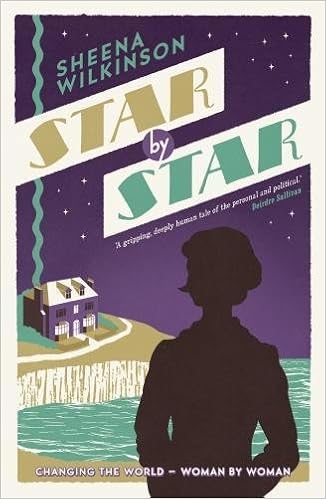
Star By Star, by Sheena Wilkinson, reviewed by Pippa Goodhart

As a teenager I loved fiction which mixed real historical interest with the gentlest sort of hint at romance. My favourite writers were Hester Burton and KM Peyton. So I was pretty sure that I was in for a treat with Sheena Wilkinson's latest novel, Start by Star. And I was right.
This story is set in Ireland at the close of the First World War, with the 'Spanish' flu pandemic killing even more than that terrible war had, with physically and mentally wounded young men returning from the front, and all whilst the question of Home Rule for Ireland is very much in the air, and (some) women were able to vote for the first time. Stella tells her story, coming to stay in Ireland with an unknown aunt after her mother dies of the flu, sharing a boarding house with a mix of characters who have different life experiences and outlooks, fighting to be recognised as more than 'just a girl', and also finding a possible worthwhile future for herself.
Stella tells her story in quite a modern voice, immediately relatable to today's child readers. She's a determined, but vulnerable, character who we immediately care for. She observes her time and place and self with insight and humour. I loved it when, for example, 'Mrs Phillips's mouth went cats-bottomy', or when Stella herself felt 'large and shy'. We know exactly what the first one looks like and the second one feels like.
It's a hundred years since women were given some voting rights in our national democracy, and that disparity of treatment, and the fight that won something coming closer to equality, must not be forgotten. Every secondary school library should have a copy of this book to help the next generation value the say they will come to have in how their country is run. And because its a very good story, well told.
Return to REVIEWS HOMEPAGE
Thursday, 12 November 2015
FIVE CHILDREN ON THE WESTERN FRONT by Kate Saunders, reviewed by Pauline Francis
I know that Kate Saunders is a huge fan of E. Nesbit’s
classic Five Children and It so – in
addition to the fact that her novel won the 2014 Costa prize and has been
short-listed for this year’s Guardian Fiction Prize – I wanted to see how she
would weave these two books together, especially since I didn’t enjoy the
original.
The Prologue begins in1905, when the Psammead (an ancient
sand fairy) takes Cyril, Robert, Anthea and Jane twenty five years into the
future (1930) to meet their old friend, the Professor. It’s only when they’ve
left that Anthea wishes that she’d looked at his photographs more clearly. She
remarks: “I didn’t see any grown-up men who
looked a bit like you boys – I wonder why not.”
She doesn’t know that the Professor is crying after they’ve
left – and so am I!
This story is wonderfully done. The Psammead re-appears just
as the First World War is breaking out. By this time, Edith, aged nine, has
been born and she is our link to the original story.
“Everything
interesting happened before I was born,” Edith sighs when she sees the Psammead
for the first time. She’d heard the wonderful stories of magic and flying
adventures from her older siblings. And what about this marvellous sentence?
Edith again: she could almost smell the
wave of magic that had suddenly swept into her life and the bigguns almost
forgot they were grown up.
How the reader wishes those children hadn’t had to grow up.
The tone of the novel slowly darkens as Cyril is sent to France,
thinking that the war will soon be over; followed the next year by Bobs and
then Anthea as a nurse at the front. The war goes on and on, as does the
Psammead’s stay with the family.
The tour de force of this novel is the back-story that is
given to the creature – “I’m a senior sand-fairy, not an animal!” he
protests. A complicated and humorous investigation by the children in the
British Library reveals that this grumpy sand fairy was once a desert god who
had killed thousands of people. He snaps, ‘I
don’t know how many of them died. Numbers aren’t important.’ Who will
forget the vision of the skeleton, pointing with its bony arm at the Psammead,
crying, “REPENT.”
This is a marvellous device, weaving the Psammead’s
predicament with the terrible war, which comes to the reader through letters,
home leave and occasional flying visits, with the Psammead, to the Western
Front. Before the poignant ending, Cyril asks the sand-fairy, ‘Since when have you cared about dying?’
In this brilliant anti-war novel, there is no attempt to
imitate E. Nesbit – just pages full of humour
and pathos, peopled by characters who are individuals that we care about, and whom
we desperately hope will survive the war.
It is the Psammead in the end who sums up war. “Wars never change. It’s basically two sides
trying to kill each other.”
The Epilogue, set in 1930, in which we meet Anthea’s
daughter, assures us that “once magic is
with us, it never disappears.”
Do I need to tell you that I’m now reading Five Children and It?
Pauline Francis www.pf@paulinefrancis.co.uk
Return to REVIEWS HOMEPAGE
Labels:
First World War,
Five Children on the Western Front,
Kate Saunders,
middle grade,
Pauline Francis
Tuesday, 20 October 2015
Out of the Dark, by Adele Geras. Reviewed by Saviour Pirotta
Publication Year: 2015
ISBN: 978-1784291259
I have to admit that I am a big fan of Adele Geras' work. My Grandmother's Stories and Voyage are wonderful reads that prove diversity and 'issue' books can be just as entertaining as fantasy or adventure. Troy and Ithaka are superb YA novels that stay true to the essence and feel of the ancient world but still manage to be relevant to twenty first century readers.
I have yet to tackle her full length adult novels so Out of the Dark, a short novella in the QuickReads 2015 series, was a perfect introduction to this side of her work . It is the story of Rob Stone, a young Londonder who has it all: matinee idol looks, a gorgeous girlfriend and a job in a fashionable store where he is much admired by the ladies. World War I robs him of all these. He returns from the battlefields with a burnt face that has to be hidden behind a mask, a girlfriend who very quickly becomes an ex and no job. He does not come home alone. With him comes the ghost of his dead captain, whose Bible and family photograph, Rob has lifted from his pack.
As the young man tries to rebuild his life, and to track down the captain's family, he finds frequent refuge in the darkness of the cinema. I can't say much more without spoiling the ending but let me assure you that this if a first rate read. It's part ghost story, part historical drama. I highly recommended it.
Follow me on twitter @spirotta
Like me on facebook https://www.facebook.com/spirotta
Website http://www.spirotta.com
Return to REVIEWS HOMEPAGE
Labels:
Adele Geras,
First World War,
Out Of The Dark,
Quercus,
Saviour Pirotta
Friday, 22 August 2014
Five Children on the Western Front by Kate Saunders reviewed by Julia Jones
“ 'We wish we could go to the
future,' Cyril said, 'But somewhere quite near, please.' ” At the beginning
of Kate Saunders's heart-wrenching final adventure of Edith
Nesbit's Psammead, the four older children – Cyril, Anthea, Robert
and Jane – are still living innocently in 1905. The Psammead is the
ancient sand-fairy who has been granting them wishes, with varying
degrees of success, since they first dug him up in the classic story
Five Children and It (1902). Nesbit's children encountered him
again in The Phoenix and the Carpet (1904) and once more in
The Story of the Amulet (1906). The
Amulet is a time travel story and includes scenes set in a benign
Utopian future which reflects the author's own Fabian aspirations. The real future for those young
Edwardians would be cruelly different. In the prologue to Saunders's Five Children on the
Western Front the Psammead sends the children forward from 1905
to 1930 to visit their friend, the professor. While they are there Anthea looks at
some photographs – but what they show is not the same as the
photographs they glimpsed during The Story of the Amulet. “ 'I saw a
couple of pictures of ladies who looked a bit like Mother and might
have been me or Jane but I didn't see any grown up men who looked a
bit like you boys. I wonder why not.'
Far away in
1930 in his empty room, the old professor was crying."
And so was I! The
current spate of World War 1 remembrances is hard on the emotions and one or
twice I've been ashamed to find myself suffering something close to compassion fatigue. I approached
Five Children on the Western Front with slight
trepidation – was it just going to be a clever idea brought out at
an opportune moment? I read it in the happiest of circumstances (lazing in
the sunshine down a river on a boat) and was completely unprepared to
find myself sobbing helplessly over the final pages. With my head I had guessed
what would happen; in my heart I was overwhelmed.
I opened that last chapter again just now to check the sequence of
events and,
dammit, I'm needing to wipe my eyes and blow my nose before I can
carry on writing.
How
has Kate Saunders managed this? Her novel is far richer and deeper
than Nesbit's and, for my taste, funnier as well. This isn't intended
to be dismissive of the Founding Mother – Edith Nesbit has a
stature and originality that the rest of us will only ever dream of – but
rereading her Five Children and It did make me aware of the
limitations of the string-of-adventures format. Five Children on
the Western Front has several story-lines, a plot, a wider
range of tones and characters and the scope to be part of something
that is bigger than itself. It's certainly a book which hits that magic, inter-generational space where both adults and children can
read with full engagement.
Five Children on the Western Front belongs less to the children than to the Psammead. The sand-fairy is in trouble,
deservedly so. “By the sound of it you behaved like an absolute cad,”
says the Lamb. “My dear Lamb everyone kills a few slaves.” He is comic, he is nasty and can be seen as the prototype of all fallen
emperors. There's a brief chapter where the action fast-forwards to
1938 and he's discovered chatting amiably with Kaiser Bill, with whom
he feels much in common.
When
the Psammead arrives back in Nesbit's Kentish gravel pit in October
1914, just as Cyril, the oldest boy, is leaving for the war, he's
been stripped of his powers. He's confused, vulnerable and furious “A
stiff little boulder of crossness” as Saunders memorably describes
him. He has been sent down to repent and it's lucky for him that
Saunders has added a sixth child, nine-year-old Edie, to the original
five. She's the only one who has time to stroke and care for him as
her older brothers and sisters cope with the army, university, school
and (for the older girls) their first attempts to challenge their parents'
pre-war expectations. They are busy and are occasionally exasperated
with Sammy's obdurate selfishness and his refusal to acknowledge his past
crimes. Edie, however, sees “bewilderment in his eyes and lurking
terror”. Her love is constant and undemanding and gives him his
best chance to learn the lessons of the universe.
The Psammead does
learn and tears are the true response. I've relished all Kate
Saunders's books since the day she bought her Belfry Witches series
to our children's village primary school but this is The One. Five
Children on the Western Front will be published by Faber in
October and I want to press it on every reading household. There is
an Author's Afterword which reminds us, poignantly, that constant
love and premature loss are not confined to 1914-1918. Some of us will still suffer “the worst
sorrow there is.”
Return to REVIEWS HOMEPAGE
Labels:
Edith Nesbit,
First World War,
Five Children on the Western Front,
Julia Jones,
Kate Saunders
Friday, 8 August 2014
‘What Passing Bells For These Who Die as Cattle?’ ‘Ellen’s People’ by Dennis Hamley, reviewed by Pauline Chandler
‘Ellen’s People’ by Dennis Hamley
Reviewed by Pauline Chandler
Most stories inspired by the First World War focus on the
suffering and horror of trench warfare, the sheer number of men killed like
animals sent to slaughter, the injustice and futility of it all. I’m thinking
about Pat Barker’s peerless trilogy, ‘Regeneration’ and Sebastian Faulks’ ‘Birdsong’,
or for young readers, Michael Morpurgo’s ‘War Horse’ and ‘Private Peaceful’.
There’s something riveting about the horrors so graphically described and I’m
sure, if you were to conduct a poll, most people would say that their first
thought when considering that dreadful conflict, is the unimagineable carnage.
But that’s only half of the picture. A whole generation of
young men was lost. What effect did that have on those who were left behind? It’s a rare writer who can go there, to make
us feel, with the utmost compassion, a common bond with people who lived in
times when manners and attitudes were so different. Dennis Hamley does just
this, in this outstanding novel.
In ‘Ellen’s People’, we see the war through the eyes of a
teenage girl, not someone called up to fight, but, poignantly, someone called
to deal with the consequences of the fighting.
Millions died, and millions lived for the rest of their lives,
with the pain of loss, bereavement and grief. Ellen represents not the courage
of the soldiers, but the courage of those who lived on, with an aching burden
of memories. When I started reading ‘Ellen’s People’, Wilfred Owen’s wonderful
sonnet: ‘Anthem for Doomed Youth’, came into my mind, especially the last few
lines, which express this so beautifully.
As Owen does in his poetry, Dennis Hamley writes with a
wider understanding of the war, not only revulsion at what amounted to mass
murder, but also the confusion and grief of those left behind, as their world
is irrevocably changed.
And not only that. Owen, a soldier at the front, could yet
see the effect of the ‘cess of war’ on both allied and enemy forces. Dennis
Hamley also approaches his subject with the same humane tolerance, offering us
a deeper awareness of the effect on soldiers on both sides.
Ellen Wilkins is sixteen when the recruitment officer signs
up her brother, Jack, along with the other young men in the village to go off
to the war. Tempers flare and the village is divided, when the local landowner,
Colonel Cripps, seems to defend the Germans, but Ellen understands what he’s
trying to say, that there are good and bad on both sides, and it would be wrong
to go to war in a spirit of anger, seeking revenge, like butchers rather than
soldiers.
These differences are highlighted in Ellen’s own home, when
her father will not hear of her working for Colonel Cripps, in his eyes a
‘toff’, one of those who prey on the working classes and enslave them in
domestic service. Ellen sees things differently. At the heart of the novel is
her journey of self-discovery, in a male- and class- dominated world, a world
at war. To be true to herself, Ellen has to defy her father and break open all
prejudices. In this she has help from one of the hated ‘toffs’, Colonel Cripps’
daughter, Daphne, who takes her to nurse in France, fulfilling her highest
ambition, and opening yet another unexpected chapter in her life.
‘Ellen’s People’ is a thoroughly satisfying read. The detail
of everyday life in 1914 is fascinating and creates an authentic setting for
Ellen’s story. Each of the characters is well delineated, with their own back stories
and motives, but especially Ellen herself, who is an appealing and ageless
heroine.
‘Ellen’s People’ is out now in an ebook edition (Kindle) ,
soon to be followed by a paperback edition, from Blank Page Press. The book was
previously published in the USA ,
under the title ‘Without Warning’.
Read more about Ellen, in the sequel, ‘Divided Loyalties’, a
story set in WWII, out on September 3rd.
Wilfred Owen - Anthem
for Doomed Youth
Written
between September and October 1917, when Owen was a patient at Craiglockhart War Hospital in Edinburgh, recovering
from shell shock.
The poem was edited by his friend, Siegfried Sassoon.
What passing-bells for these who die as cattle?
Only the monstrous anger of the guns.
Only the stuttering rifles' rapid rattle
Can patter out their hasty orisons.
No mockeries for them from prayers or bells,
Nor any voice of mourning save the choirs,—
The shrill, demented choirs of wailing shells;
And bugles calling for them from sad shires.
Only the monstrous anger of the guns.
Only the stuttering rifles' rapid rattle
Can patter out their hasty orisons.
No mockeries for them from prayers or bells,
Nor any voice of mourning save the choirs,—
The shrill, demented choirs of wailing shells;
And bugles calling for them from sad shires.
What candles may be held to speed them all?
Not in the hands of boys, but in their eyes
Shall shine the holy glimmers of good-byes.
The pallor of girls' brows shall be their pall;
Their flowers the tenderness of silent maids,
And each slow dusk a drawing-down of blinds.
Not in the hands of boys, but in their eyes
Shall shine the holy glimmers of good-byes.
The pallor of girls' brows shall be their pall;
Their flowers the tenderness of silent maids,
And each slow dusk a drawing-down of blinds.
Pauline Chandler
www.paulinechandler.com
Return to REVIEWS HOMEPAGE
Labels:
First World War,
history of nursing,
Horatio Bottomley,
railway history,
social history,
women's rights,
worker's rights,
WWI
Subscribe to:
Posts (Atom)


.jpg)