Showing posts with label bullying. Show all posts

Tuesday, 11 September 2018

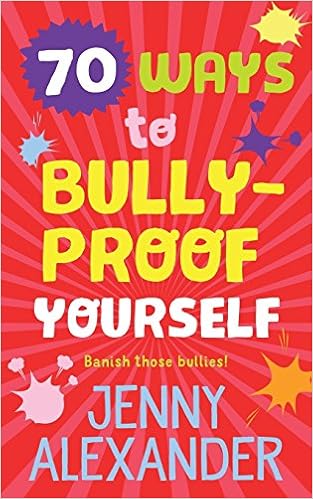
70 Ways to Bully-Proof Yourself, by Jenny Alexander, reviewed by Pippa Goodhart


This is a book that is very much on the side of children experiencing bullying. It is kind and clear and properly helpful.  Divided into short chapters, and each of those is subdivided into the making of clear points, illustrated with brief example stories, followed by a series of positive activities you can do to strengthen yourself against bully attack.  From the start we’re given permission to use the book as we like, perhaps skipping parts or going to the headings that most interest us. The range of activities will give something to suit all temperaments.  Some are logical, almost scientific, in their approach, creating charts and diagrams. Others are more arty, tearing up magazines to make mood pictures.  Some are simple and private, just thinking of words at particular moments.

The book tackles different kinds of bullying, from the physical assault, being ambushed on the way home from school, to the ‘we were just having a laugh’ kind of bullying that puts the blame onto you for not having a sense of humour.

Down to earth, and told with humour (‘Shit happens, but it makes great manure!’), the advice feels practical and friendly, but also, very importantly, realistic.  Jenny Alexander recognises that there are risks with telling teachers or parents about bullies, so gives a range of sources of help.  The main source of help is yourself once you are armed the techniques she teaches here.

This book claims that to equip you against bullies in ways that are easy, not scary, that work, and that give you skills for life.  And all of that’s true.

Laid out with humorous pictures and sub-titles so that there are no daunting pages of solid text, this is a book that addresses the reader directly, as a friend.  That reader could be a KS2 child, but could equally well be somebody in secondary school, or an adult.  I found it an empowering book.  It would certainly be a useful tool for teachers; a great resource for any wanting to do assemblies or other sessions about bullying.  Every school library should stock this book because every school suffers from bullying.  


Return to REVIEWS HOMEPAGE

Thursday, 12 January 2017

What I Couldn't Tell You by Faye Bird, reviewed by Dawn Finch

First the blurb....

When love turns to jealousy, when jealousy turns to rage, when rage turns to destruction...

Laura was head over heels in love with Joe. But now Laura lies in a coma and Joe has gone missing. Was he the one who attacked her?

Laura's sister Tessie is selectively mute. She can't talk but she can listen. And as people tell her their secrets, she thinks she's getting close to understanding what happened on that fateful night.


YA books about young people with "issues" are very on-trend at the moment and so, when a friend recommended this book to me, I must confess to some resistance as I've read far too many "worthy" books recently and was becoming a little jaded with them. Don't get me wrong, many of these books are important, but there are an awful lot that are not. I was wrong to dump this book in with the masses, Faye Bird has given us quite a different thing. This is a book about a girl who is caught up in a terrible event, a girl who desperately wants to know what happened to her sister, a girl who wants more than anything for her life to go back to what it was before the attack, a girl who like all teens just wants to be happy and to have friends - and this girl happens to be selectively mute. 

Faye Bird has achieved a remarkable thing here, she has managed to deliver to the reader a very detailed understanding of the life of a SM young person, without ever being patronising or giving us infodumps. She does this by putting us firmly in Tessie's shoes. The prologue sets the scene by introducing us to Joe and Laura, but when we move on to the next chapter we are with Tessie. Bit by bit details of the attack on Laura trickle into our laps but, just like Tessie, we are mute. As readers we want to shout out to Tessie, to warn her, to tell her what we think, to tell her what is really going on... but we can't. We want to tell Tessie to go to someone, we want to share what she knows but we too are mute and can't be heard.

Characterisation is so well handled in this novel that I bonded quickly with Tessie as she is incredibly likeable. I became so fond of her and found myself missing her when I finally closed the book. Her frustrations and confusions become ours, we feel her struggle and I know that YA readers will find a great deal to identify with in the twisting and turning sub-plots.

I particularly like the fact that Bird does not neatly solve everything with a perfect happy ending. Life isn't like that and not every broken thing can, or should, be fixed.


What I Couldn't Tell You by Faye Bird was published by Usborne in May 2016 and is available in both print and e formats. You can find out more about the author on her website www.fayebirdauthor.com

Review by Dawn Finch, children's author and librarian. www.dawnfinch.com


Return to REVIEWS HOMEPAGE

Friday, 22 January 2016

THE ICARUS SHOW by Sally Christie Reviewed by Adèle Geras


We know what happened to Icarus. He put on  a pair of wings made by his father, flew too near the sun and fell to his death. The  striking cover of Sally Christie's new novel  has chosen to emphasise the myth and at first sight, this doesn't look like a book set in the present day and in a world we recognise. There's a mythic quality to the image.

The story is about a boy, Alex, and his problems and the way he deals with them but it's also about much more than that.  It shows that even the most ordinary lives can be transformed: by unexpected events and people with whom on the face of it you have little in common. 

Alex has adopted a strategy to avoid being bullied  and picked on at school. He lies low and does not react - not to anything. This is presented  to us matter-of-factly:  it's what you have to do to get by each day, but when the reader pauses to think, it's a heartbreaking way for a young boy to spend his entire school day. His 'trust no one' policy means, of course, that he has no friends. He used to have a friend, who's  moved to another part of the country.  A boy called Dave Marsh, known as Bogsy, lives in the house next door, but Alex misses his old neighbours, Maisie and Don, an elderly couple.  When Don died, Maisie, who was like a granny to Alex,  went to live in a care home called The Laurels. Their son, also called Don, lives in Australia.

Then one day Alex finds a feather in his schoolbag and a note saying "A boy is going to fly. Will you be there?" At first, he thinks he's the only one to get such a message but he later discovers that others have had it too, and he sets out to find out who wrote it and even more importantly to wonder: will it happen? Were such things possible?  Would a boy fly? And what would be the consequences if he did?

Alex visits Maisie every Saturday.  She has Parkinson's and  is sometimes confused but he enjoys talking to her and she still has decided opinions about everything.

Then he discovers that Bogsy is making a pair of wings in the shed next door.  Alex recognises the feathers he's using and the two boys form a relationship as they work on the wings together, and and it's this strange  friendship  that colours the second half of the book. 

I'm not going to spoil the story by telling you any more. You will have to read it to find out about the flying:  about how the wings will  be used, and especially about how Alex's whole outlook on life  is changed by the Icarus Show.

The book is brilliantly written.  Alex tells the story  and he's a sympathetic narrator, and uses simple language very effectively to take us into the classroom, the care home, and especially Bogsy's shed, which becomes a kind of workshop for a modern day Daedalus. 

The Icarus Show tells us, subtly and without  raising its voice,  about the way depression works,  the things that bullies do and perhaps something of why they do them, how quite troubled children can react to their circumstances and the extent to which unhappiness can be hidden or twisted into many different shapes. It also emphasises the importance of communication: between friends, between members of a family and especially between one generation and another.

Full disclosure:  Sally Christie is a friend,  but you will have to believe me when I say, (I've said this in almost every review I've written for this website) that I wouldn't recommend something I didn't love.  I loved this book, and I'm sure that many, many readers are going to agree with me. 

Published in hardback by David Fickling Books £10.99
ISBN: 9781910200483

Return to REVIEWS HOMEPAGE

Friday, 22 May 2015

SECRETS AND DREAMS by Jean Ure. Reviewed by Adèle Geras


Anyone who reads my reviews regularly knows that I have no  shame when it comes to writing about books by my friends. My feeling is:  reviews  for most children's books are few and far between and anything I can do to draw people's attention to something they might enjoy, I try to do. And as I've said many times, it's not my fault that many of my chums are good writers. 

Jean Ure has written every kind of book in her time. In the last while, she's concentrated on a certain kind of story. To quote Jacqueline Wilson on the cover: "Fun, funky, feisty...and fantastic reads."

That is all true, but it's worth saying something more about Ure's books. The thing about them is: they're  well-written (not a given in books of this kind!) and even though they are decked in flowery, brightly coloured, girl-oriented covers they are never soppy, or silly and they never talk down. They are also almost always funny at least in the way they are written, if not always in their subject matter.

This story is about Zoe, whose family has won a large sum of money on the lottery. Each member of the family can choose to do something they really, really want and what Zoe wants is to go to boarding school. She has been influenced by Enid Blyton of course...and St Withburga's ( Cheeseburga of course!) is where she ends up.

The rest of the novel is about how she adjusts to being at school and how she negotiates the various friendship groups. Ure discusses how they change,  how they affect different  girls. She deals well with the day to day stuff of boarding school: the importance of nicknames, the status you get from having a boyfriend, the longing to be included, and accepted. I know from having a 12 year old granddaughter that her friends are a tremendously important aspect of her life, and I can even remember, across a distance of more than half a century, how painful and hideous any kind of exclusion can be when you're at boarding school...which I was, for eight years. 

Jean Ure's books are easy to read.  This one is in the first person. There's lots of dialogue and the characters are skilfully drawn and well differentiated.  They should not therefore be dismissed as frivolous. She deals with real issues, and in a light and interesting way. The books are nicely produced, and not very long. They are just the thing for the summer holidays, if you have young teenagers looking for a pleasant way to pass the time. Read this one and there are many others by Ure that you can go on to. I do like a writer who's got a long backlist! A very enjoyable book indeed.


Published by Harper Collins in pbk. £6.99
ISBN: 9780007553952

Return to REVIEWS HOMEPAGE