Showing posts with label Ireland. Show all posts

Sunday, 7 January 2018

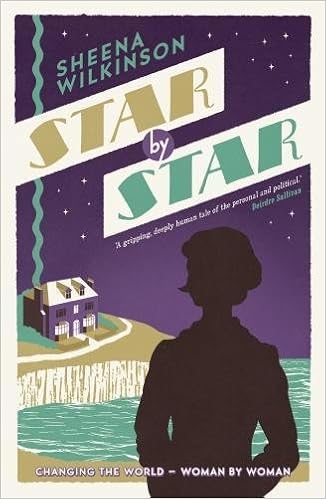
STAR BY STAR by Sheena Wilkinson. Reviewed by Adèle Geras


I hope it's not too late to wish all readers of this blog a very happy 2018. The year is significant. It's the centenary of the first ever election in which women (over thirty years old, and householders, but still) were allowed to vote. Today's young people, for all that  more and more of them are involved in politics, do not, I think, fully appreciate the work of past generations of women in the struggle  to win the right to have a say in the way that they're governed. I feel that  people of all ages and both sexes take the vote for granted and the figures of the turnout always astonish me.  I often think voting should be made compulsory, as in Australia, and I certainly think that you lose many of your moaning-about-the-government rights if you didn't even bother to turn up at the polling station.


All congratulations, then, to Sheena Wilkinson for being very fast off the mark this year with an informative, interesting and engaging novel for young people. Teachers all over the British Isles, as well as in Ireland, will be grateful to Wilkinson for providing a human and touching account of how things were in December a hundred years ago.

A disclaimer follows. This writer is a friend of mine and we each had a story in the anthology called THE GREAT WAR, which was published in 2014 by Walker Books. That book marked the beginning of the War and this novel (published in paperback by Irish publisher, Little Island) marks its end. Wilkinson has much to say about this period and this novel, even while it's very enjoyable as a story to entertain and move its readers, is also a good introduction to the history of the period in  Ireland. There's a very useful note before the story begins which explains the historical background for young readers clearly and once a reader embarks on the actual story, she already knows all the necessary facts.

And there is much to take in. The Great War, the pandemic of Spanish flu that followed it, the situation of women in Ireland, the various factions seeking the vote in the December election and above all, the fight, over decades, for women to be allowed to have a say in who governs them: all these matters are discussed here in one way or another. 

We follow Stella, whose suffragette mother has died of the flu in England, back to Ireland and we meet a whole cast of fascinating characters who over the course of the book, both teach Stella many things and also learn many things themselves. She goes to live with her aunt Nancy, who runs a guesthouse called Cliffside House, one of whose residents doesn't eat with the others. This is Captain Reid, who has served in the Great War and who ends up being important to the narrative. The other residents and the life of the small town are beautifully described. Every character springs to life and Stella herself is an engaging and amusing narrator of her own story and that of the fight for suffrage. 

Cars are just beginning to be used for getting about and poor Stella is very car sick throughout the book. This can sometimes be funny but mostly it's a metaphor for 'feeling the fear and doing it anyway.'

There are revelations and surprises throughout the novel and I'm not going to give any of those away, but I urge you to read this excellent and important book, and to give it to any teenager who's studying The Great War. This part of that conflict is not often written about. The attention of most people writing about the period is often on the men fighting the war, so all credit to Wilkinson for highlighting the struggle of women for their rights. 

Return to REVIEWS HOMEPAGE

Monday, 4 December 2017

Star By Star, by Sheena Wilkinson, reviewed by Pippa Goodhart

Image result for star by star image she

As a teenager I loved fiction which mixed real historical interest with the gentlest sort of hint at romance.  My favourite writers were Hester Burton and KM Peyton.  So I was pretty sure that I was in for a treat with Sheena Wilkinson's latest novel, Start by Star.  And I was right.

This story is set in Ireland at the close of the First World War, with the 'Spanish' flu pandemic killing even more than that terrible war had, with physically and mentally wounded young men returning from the front, and all whilst the question of Home Rule for Ireland is very much in the air, and (some) women were able to vote for the first time.  Stella tells her story, coming to stay in Ireland with an unknown aunt after her mother dies of the flu, sharing a boarding house with a mix of characters who have different life experiences and outlooks, fighting to be recognised as more than 'just a girl', and also finding a possible worthwhile future for herself.

Stella tells her story in quite a modern voice, immediately relatable to today's child readers.  She's a determined, but vulnerable, character who we immediately care for.  She observes her time and place and self with insight and humour.  I loved it when, for example, 'Mrs Phillips's mouth went cats-bottomy', or when Stella herself felt 'large and shy'.  We know exactly what the first one looks like and the second one feels like.

It's a hundred years since women were given some voting rights in our national democracy, and that disparity of treatment, and the fight that won something coming closer to equality, must not be forgotten.  Every secondary school library should have a copy of this book to help the next generation value the say they will come to have in how their country is run.  And because its a very good story, well told.

Return to REVIEWS HOMEPAGE

Tuesday, 22 November 2011

THE RABBIT GIRL by MARY ARRIGAN : Review by Penny Dolan


All Mam’s comforting clutter had been hidden away. Even the picture of rabbits in a field was covered by a white cloth.
            “We’ll go there,” Mam used to say. “You and me, Tony, we’ll go there and play with those rabbits.” Maybe that’s where Mam is, thought the little boy. Maybe she’s gone to play with the rabbits and is waiting for me.”


Rabbit Girl is a tale of two lives that meet in a pet shop. It begins back in 1934 Ireland, when five-year old Tony is taken to say goodbye to his dead mother. Too soon, his father has to go to London to find work, leaving Tony with a neighbour, Mrs Mooney, and the bullying of the local rabbit catcher’s sons. A year later, his father returns to collect Tony and take him back to life in a room in a tenement block, and the occasional care of kindly Doris.
Eventually, as time goes on, Tony returns to the green of the countryside, but as an evacuee, extra labour for a farmer whose son is away.

The hard tale of Tony’s life is balanced and warmed by the character from the present day: Mallie, a lively fifteen year old girl. Although Mallie has problems, being almost a carer for her mother who is a depressed artist, the pages are very much brightened by the jokes, laughter and fun that Mallie shares with her bold best friend Jamila throughout the book: a most wonderfully described relationship.

Mallie is desperate for money to buy her mum a birthday present so she takes on a secret part time job in a pet shop, offered to her by Steve, the man behind the counter, who is caretaking the shop while his dad is in a convalescent home.
Mallie copes with many trials and tribulations, including fear of her job being discovered, the return of Mr Armstrong the ill-tempered pet-shop owner, as well as her attempts - encouraged by Jamila - to bring employment and happiness into her own mother’s life.

Mary Arrigan skilfully weaves chapters from the past among Mallie’s modern life. Gradually we learn about Tony’s friendship with his fellow evacuee Alice during war time among the Lakeland fells. We also discover, as Tony and Alice do, another important character -  a woman farmer and artist at Hill Top Farm, Windermere - and about a drawing of rabbits among green grass that brings rage so many years later.

I felt the writing style of this book was very nicely judged for the older junior/KS2 or the young teen reader.  Although Mary Arrigan tells the story lightly and almost swiftly, her scenes still captures the impact of moments of pain or sadness. I also liked the way she offers a non-simplistic approach to past times, hinting at the true economic necessity behind what now seems like harsh treatment.

Bit by bit, the reader, often alongside the memorable Mallie, understands the reasons behind the older characters behaviour and actions and the story circles round in a satisfying way.  An enjoyable and thoughtful book.
 
By the way, all this is written in awareness of the particular surname, Dolan, that Mary Arrigan gave to that rabbit catcher and his bullying sons.

Penny Dolan
www.pennydolan.com

The Rabbit Girl by Mary Arrigan. Published by Frances Lincoln at £6.99.
ISBN 978-1-84780-156-2

www.maryarrigan.com


Return to REVIEWS HOMEPAGE