Showing posts with label Rosalie Warren. Show all posts

Saturday, 30 March 2013

'Everybody Jam' by Ali Lewis: reviewed by Rosalie Warren


This fab book takes us to the heart of Oz for a blast of life in the out back with a boy called Dan, and deals with grief and loss as well as the trials of young Liz, the Pom who has come to help out on the farm. 

Sorry if that opening sounded a little stilted, but I was setting myself the challenge I woke up to on Radio 4 this morning - of summarising a book in a single sentence, using words of only one syllable. OK, so I cheated a bit by splitting 'outback' into two words - but other than that I think I've covered the essentials.

 Dan (or rather Danny) is thirteen and lives on a cattle station near Alice Springs (actually 200 miles away, but it's the nearest town of any size...) with his parents and two sisters, one of whom, Sissy, aged fourteen, is pregnant. A tragedy hangs over the family: about a year ago Danny's older brother Jonny died in a terrible accident. Danny can't find anyone who wants to talk about Jonny. The family avoid mentioning him, while struggling on as best they can, trying to make ends meet and looking after their cattle on the drought-stricken land.

'The Pommie' arrives - Liz from England, who Danny's father says speaks like the Queen and is far too weak and skinny to do anything useful around the place. She can't even, it seems, make breakfast for the family without nearly burning the house down. And when she tries to drive one of the utes it's another near-disaster. In Danny's opinion she should be sent straight back to where she came from. But the Pommie is tougher than she looks and before long she has grasped the principles of life on the cattle station and is pulling her weight. Not only that, but she asks Danny some questions about Jonny, his dead brother, and opens up the way for him to begin to talk about his loss.

There is plenty more going on. Danny is given an orphaned young camel to rear - the boisterous Buzz, who gives Danny some worrying moments but also provides him with a job that's all his own. Danny is helping with the cattle muster (round-up) for the first time this year, and is determined to make a good job of things and to honour the memory of his brother.

We also learn about the relationships between Danny's family, the neighbouring white farmers and the aboriginals who live nearby. And there's a challenge for Danny's dad when he discovers the identity of the father of Sissy's baby.

This is a coming-of-age novel with a difference. From page one the reader is plunged into what for me was the wholly unfamiliar world of life on an Australian cattle station. But Danny's voice and personality quickly make us feel at home there. He has a wonderful way with words and his descriptions had me laughing out loud at times. Yet there's real feeling too - a boy who has lost his brother and feels unable to talk about it with anyone else. And the young woman Liz (who I'm guessing from the Acknowledgements may be based just a little on the author's own experiences in Australia). Seen through Danny's eyes, she makes ridiculous and hilarious mistakes, but she engages our sympathy from the start and it's impossible not to see the story from her perspective.

To my surprise, the 'Everybody Jam' of the title turns out to be a noun phrase, not a command. You'll have to read the book to find out what it means.

Danny is a tough lad with a heart, and his story made me both laugh and cry. This is a book for age 12+, I'd say, and should appeal to both boys and girls. And grown-ups...

I'm hoping to see more from Ali Lewis.


Book details:
Title: Everybody Jam
Author: Ali Lewis
Publisher: Andersen Press
Publication Date: 2011
ISBN: 978 1 84939 248 8
*** Unsuitable for younger readers***


Happy reading,
Ros

My blog
My website
My Facebook author page
My alter ego, Dr Sheila Glasbey 
Follow me on Twitter @Ros_Warren  


Return to REVIEWS HOMEPAGE

Tuesday, 19 February 2013

'Blame My Brain' by Nicola Morgan, reviewed by Rosalie Warren


As someone who constantly blames my brain for all sorts of things (not my fault - my brain did it!), I was intrigued by the title of Nicola Morgan's book and only slightly disappointed to learn that it was aimed at teenagers. Since I have many days when I feel that I am barely out of my teens (though the mirror, sadly, does not bear this out), I decided that the book might still be relevant to me, and indeed to my relationships with my no-longer-teenage children.

The subtitle is 'The amazing teenage brain revealed' and amazing is, I soon discovered, exactly what the teenage brain is. I learned that one of the things that happens to the brain in our early teenage years is a flurry of growth of the dendrites (connections between neurons), followed a few years later by a major pruning session where many of the relatively unused connections are culled and the remaining ones are strengthened and coated with a fatty myelin layer ready for adult life. Not surprisingly, all this activity is not without its downside for the person 'within', and it goes a long way towards explaining why teenagers can be so difficult to live with (and can find it so difficult to live with themselves).

There are also brain-based explanations of why teenagers need so much sleep, why they don't tidy their rooms, why they come alive when the rest of the world is going to sleep and why some of them, at least, are risk-takers. There's stuff about alcohol and drugs and why such things are not good for the brain, but all of it is written in a very sympathetic and understanding way that I think teenagers will warm to.

Nicola Morgan is not a neurologist or a professional scientist, but she clearly done a great deal of research and consulted experts including Professor Simon Baron-Cohen and Professor Susan Greenfield, among many other eminent names in the field. Morgan has a gift for simplifying and explaining complicated subject matter with a light but precise touch, and she is careful to distinguish between established facts and theories and speculations of her own and other people's.

There's plenty of humour and a good few well-deserved digs at the crass stupidty of parents and other well-meaning but misguided adults, which teenagers will appreciate. There are diagrams, tests, photos (what emotions can you recognise? Do you confuse other emotions with anger? Apparently the teenage brain often does, which may explain quite a lot). What kind of thinker are you - which mental tasks do you find comparatively easy or difficult? There's also sound advice about addiction, self-harm, depression and other mental illnesses, and some pointers towards recognising when you may need to seek help.

The illustrations by Andy Baker are great, too. And oh yes - there's some interesting discussion on the differences between girls' brains and boys'. If there are any. You'll have to read it to find out...

I wish I'd had this book when I was a teenager (wish my parents had had a copy too). And that it had been around when my children were that age. It might have made me a better parent. Ah well - I will make sure I buy copies for any grandchildren I have, when they reach their teenage years.

This book was first published in 2005 and, I am sure, must have helped a great many young people and their parents and other carers since it first came out.

Details:
Title: Blame My Brain
Author: Nicola Morgan
Illustrator: Andy Baker
Publisher: Walker Books Ltd
First Published: 2005

Happy reading! Best wishes,
Ros

My blog
My website
My Facebook author page
Follow me on Twitter @Ros_Warren  


Return to REVIEWS HOMEPAGE

Tuesday, 22 January 2013

'A Voice in the Distance' by Tabitha Suzuma - reviewed by Rosalie Warren


 A few months ago, I asked my fellow authors on 'An Awfully Big Blog Adventure' what novels they had read featuring characters with bipolar disorder and which ones had best stuck in their minds. I was looking for books for adults as well as ones for younger readers, and was delighted to be introduced to several I hadn't previously known about, right across the age-range.

One of these was A Voice in the Distance by Tabitha Suzuma. This book says on the back cover: 'Not suitable for younger readers', but I would be happy to give it to anyone of about 13-14 upwards, though of course it's difficult to generalise. It's written in a very responsible way, but some of the content may be upsetting to some younger readers, or simply 'beyond their ken'.

Flynn Laukonen, the main protagonist, is a brilliant young pianist with a a wonderful career ahead of him. His girlfriend Jennah is a musician, too. Both are students at the Royal College of Music and share a flat. But Flynn is bipolar and relies on his daily medication to keep him from the wild excesses of mania and the depths of depression. Early in the book, he is hospitalised when his medication suddenly stops working, and Jennah is called upon to support him through this horribly difficult time. As the story progresses, tensions develop between Flynn's need of medication and his ability as a performer. His new pills cause his hands to shake, which is out of the question for a concert-level pianist. And, without them, Flynn believes he can attain heights of brilliance that are blocked by the medication.

The resulting chaos strains Flynn's and Jennah's relationship to the limit, and the book ends with some incredibly difficult decisions on both their parts. I found it impossible to predict how the story would end, and the conclusion left me in tears. It was all beautifully done, and I felt that the way alternating chapters were narrated by Flynn and Jennah worked very well indeed (after, I have to say, some initial scepticism on my part about this technique). I was given deep insights into both their personalities and the difficulties faced not only by people with bipolar but their friends and loved-ones too.

I also throughly enjoyed being immersed in the world of music students. The one thing I found a little hard to believe was their apparent lack of money worries, but apart from this, the scenes of student life, lectures, practice and so on were very convincing. The characters were all well-drawn, including the supporting ones, with plenty of mention of family as well as friends, which made a pleasant change from many books for this age-group.

Flynn's love of music shone from every page, as did his terrible struggles with his mental demons. I particularly liked the description on p.179 of how it feels to have depression. I am a sufferer from this condition myself and am not sure I have ever read a better account (and I include in this the US writer William Styron, whose Darkness Visible is my depression bible).

Any young person with a mental health problem would benefit, I'm sure, from the honesty that pervades this book. But the story is for anyone - the characters are alive, real and at times very funny. The narrative swings along at a good pace and keeps you hooked. In these days when many of us are clamouring for more novels (for all ages) that feature mental health - this is a joy to read. Suzuma does not hold back from confronting some of the toughest issues many of us will ever have to face.

Very highly recommended.


Book Details:
Title: A Voice in the Distance
Author: Tabitha Suzuma
Publisher: Definitions (Random House)
Publication Date: May 2008


This book is a sequel to A Note of Madness (2007).

All best wishes,
Ros

My blog
My website
My Facebook author page
My alter ego, Dr Sheila Glasbey 
Follow me on Twitter @Ros_Warren  


Return to REVIEWS HOMEPAGE

Friday, 30 November 2012

Really Weird Removals.com by Daniela Sacerdoti: Reviewed by Rosalie Warren

Cover illustration by Nicola Robinson


Is your home infested with anything you would like to have removed? A stranded sea serpent, perhaps, or a smelly troll, werewolf or baby dragon?

If so, you may like to know about ReallyWeirdRemovals.com, who specialise in the safe (and, on the whole, humane) removal of such creatures to places better suited to their idiosyncratic lifestyles and eating habits. The website is a real one, and you are invited to email them with your requests for help. (I don't think they deal with more common pests such as rats and wasps' nests, though.)

Luca, aged twelve, and his sister Valentina, eleven, live on an island called Eilean, off the west coast of Scotland. They have a rather scatty and delightful Italian mother who puts homemade pasta in their lunch boxes and lives, Luca tells us, in a world of her own, venturing out every now and then to look after her children. Luca's father is a writer who spends a lot of time alone, creating a series that aims to be as successful as Harry Potter - and, meanwhile, neglecting his own family just a bit.

The story begins when Luca's Uncle Alistair turns up in a blue van, announcing the set-up of his new pest-removal company. The children soon discover, however, that the pests to be removed are not the common or garden kind but supernatural creatures like kelpies and trolls.

Once the parnaormal element is introduced, the story bounces along, throwing up creatures yet more weird and wonderful with every chapter. Not all the beasties are dangerous and some are very appealing, like the female zeuglodon and her baby, Finlay. There's also Camilla, a lonely girl ghost who has been thrown out of the home she used to haunt and is looking for a family to take her in.

I love the way that many of the creatures come from Scottish folklore and mythology. The Luh, for example, is a Scottish werewolf. Kelpies look like ordinary women but can turn into white horses and are fond of eating children. Selkies are half-seal, half-human. Even the inevitable vampires have a Scottish flavour - they are known as Baobhan Sith and, with their long red hair, chalky faces, deer hooves and blood-sucking talons, could give some of the more conventional literary vampires a run for their money.

Life on a small Scottish island comes fully alive as we follow the adventures of Luca and his family. There's a longstanding argument between Uncle Alistair and his brother Duncan, Luca's father, which centres around the disappearance many years ago of their parents - lost, it seems, in an unfortunate time-fold experiment. The family relationships are warmly and convincly portrayed and contrast nicely with the scary stuff.

There is nothing too frightening here - just enough to provide excitement and chills. Young people from around 9 upwards will enjoy this greatly. Floris Books are a thriving independent publisher based in Edinburgh and this book is one of their 'Kelpies' series. I hope it gets the wide audience and enthusiastic response it deserves. I have a feeling more will follow!

(Just a final note to the copy-editor: Please change the last word of the book from 'I' to 'me'. I don't expect the ungrammaticality will bother many children, but it stuck in my craw, coming, as it did, at the end of a tasty feast!)

Book Details:
Title: Really Weird Removals.com
Author: Daniela Sacerdoti
Cover Illustrations: Nicola Robinson
Publisher: Floris Books, Edinburgh (Kelpies imprint)
Publication Date: October 2012
ISBN: 978-0863159022
Cover Price: £6.99 UK
On Amazon UK


Review by Rosalie Warren, author of Coping with Chloe
See my blog, Rosalie Reviews
My Facebook Author Page
Follow me on Twitter @Ros_Warren


Return to REVIEWS HOMEPAGE

Friday, 19 October 2012

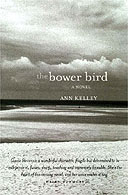
More about Gussie! Ann Kelley's 'The Bower Bird', reviewed by Rosalie Warren


The Bower Bird by Ann Kelley

Recommended reading age: 12+

Ann Kelley's books about Gussie (Augusta) Stevens deserve, in my opinion, to be much, much better known and much more widely read.

Gussie, aged twelve, is waiting for a heart and lung transplant. She suffers from pulmonary atresia, which means that her blood is insufficently oxygenated and her skin, as a result, is purple or sometimes even blue. She has difficulty walking very far and she can't go to school in case she picks up an infection.

But Gussie's life is as far from dull and restricted as it's possible to be. She lives in St Ives with her mum and is a keen (and amusing) observer of all the human, animal and birdlife in and around the town. She has three cats, including Rambo the Terrified, who runs for cover every time someone stands up. From her attic room, Gussie watches the herring gulls nesting and bringing up their young - including the one who stubbornly refuses to leave home. 'Only a parent could love an adolsecent gull,' Gussie comments. We also hear about the lizard in the terrarium - the one with SED (sadistic eating disorder), which Gussie eventually sets free because she can't bear to see him slowly work his way through any more half-alive grasshoppers.

Gussie is funny. Her story is unbearably moving at times, partly because it's told without sentimentality or self-pity. Gussie is pragmatic. She may only have a year or so left to live, so she's determined to make the most of every moment.

She tells us about Brett, the young Aussie guy she's fallen in love with. We hear a lot about Mum, who capitalises her words, saying things like: 'There's Nothing Wrong with Mouse' [the colour of Gussie's hair]. Mum, apparently, is not very good at talking to Gussie, except to tell her not to do things. As adult readers we get telling glimpses into the life of Capitalising Mum - and just a taste of what it might be like to have a daughter like Gussie to cherish and worry constantly about. Mum has managed to provide her daughter with the perfect environment for her personaility and condition. Dad, a photographer and film-maker, has left them for TLE ('The Lovely Elise') and lives in London. Gussie is keen to trace her family on her dad's side. There are lots of Stevenses in St Ives and we see her start to get to know some of them and discover family connections.

Gussie's descriptions are so apt and beautiful they sometimes hurt. How about (from p.18): 'The sea is hammered pewter and the low waves are mercury creeping up the beach'? Too precocious and 'poetic' to come from a 12-year-old? Well, no - not if you read it in context. Gussie's voice is very much her own. An unusually clever and well-read 12-year-old, yes, but a 12-year-old just the same - ordinary (in many ways), likeable, outgoing, curious about everything. How does Ann Kelley do it? Perhaps, when I read this book for the fourth time, I'll finally get down to studying her technique, rather than simply being enthralled. Perhaps...

Gussie is now on my own personal shelf of favourite characters from books. She's up there with Moomintroll, Just William, Jo March, Dorothea Brooke, Holden Caulfield, Paddington, and Ramona Quimby. Characters I Would Like to Meet and Be Best Friends With...

There are four Gussie books. At the end of this one, The Bower Bird, a set of heart and lungs becomes available and Gussie is rushed off, at Christmastime, to hospital in London to have her transplant. In the next one, Inchworm, we hear from Gussie about the transplant and its aftermath. And in the fourth one, A Snail's Broken Shell, she tells us what it's like finally to have pink skin and be able to go to school. As you might expect, she has many new challenges to face. She also meets the family of the young woman who died, whose heart and lungs are now working inside Gussie's body. Here Ann Kelley's touch, as always, is perfect.

The Bower Bird was a category winner in the 2007 Costa Book Awards, and it's not difficult to see why. What I don't understand is why these books aren't more widely known and read. They have much to offer to both youngsters and adults. They are absolutely not 'aimed at' youngsters with heart problems, though they might well have particular relevance to such young people and their families. But they are quietly funny and their observations of parents and grown-up life (as well as seagull life) are spot on.

My copies are getting tatty. Need I say more? Please read, enjoy and recommend them widely.


Publisher: Luath Press Ltd (10 May 2007)
ISBN-10: 1905222793
ISBN-13: 978-1905222797
View 'The Bower Bird' on Amazon UK

Happy reading,
Ros

My blog, Rosalie  Reviews
My Facebook Author Page
My webpage
Follow me on Twitter @Ros_Warren


Return to REVIEWS HOMEPAGE

Thursday, 13 September 2012

'The Burying Beetle' by Ann Kelley, reviewed by Rosalie Warren

[Recommended age: 10+ approx]


I can't remember how I came to stumble upon The Burying Beetle. It was first published in 2005 and I missed it completely at the time. This may have been because it predated my current interest in YA fiction, or perhaps it did not receive a great deal of publicity, being published by Luath Press, one of the smaller publishers.

But oh boy - am I glad I found it. And not just The Burying Beetle but its two sequels, The Bower Bird and Inchworm, at least one of which I plan to review on here soon.

The protagonist is Gussie Stevens, aged twelve. Her story opens on August 11th, 1999, which, you may or may not remember, was the date of the total eclipse of the sun, viewable in totality from Cornwall. The eclipse is significant to Gussie, partly because it happens on her twelfth birthday but also for reasons far deeper, all connected with her recent move to St Ives with her mother and her growing interest in the bird, animal and human life of the area.

Gussie is a contemplative girl - a keen reader and observer. This is forced upon her to some extent by her condition - she can't get around very much. The older and bigger she gets, the more her heart has to struggle. When she was young, she could run and jump, but now it's difficult to walk very far without getting out of breath and exhausted, owing to her medical condition, pulmonary atresia, which means that she lacks a pulmonary artery and her blood is receiving a lot less oxygen than it needs.

The condition is fatal for some, but Gussie has, if I've understood her correctly, compensating defects in her circulatory system which mean that her blood does get some oxygen, allowing her to live a rich and interesting, if somewhat restricted, life. Gussie's observations of her three cats, as well as the local gulls, beetles, mice, dolphins, seals and humans, made me smile as well as teaching me a lot. Her attitude towards her illness is never self-pitying - she deals with it in a matter-of-fact way which is not only inspiring but deeply moving at times. Her relationship with her mother is drawn finely and with conviction. You can't help loving both of them, and the cats and other creatures too (especially the grouchy adolescent gull who refuses to leave home!).

Gussie can't go to school because of the risk of picking up infections. She's lonely, of course, and she misses her London life, but soon she starts to make friends with a number of local residents and discoveres that her father (still living in London, now with The Lovely Eloise) has relatives in the town. Slowly, St Ives becomes home, and Gussie shares with us her observations of the seashore in all its moods. She's not afraid to tell us about the anger and jealousy she feels at times, and about her grief over the loss of her grandparents. Altogether, this is a profound, thoughtful and convincing book. But don't go away with the impression that it's heavy and sad, because it's not. Gussie has a tremendous love of life and is determined to make the most of however much (or little) of it she has left.

I think there is something for every age here. Ann Kelley says she does not write for children but for readers, and that shows through every page. She also tells us that Gussie's story is partly based on that of her own son, who also had pulmonary atresia. That helps explain why she gets it all (as far as I can tell) so 'right'. But she is a fine writer, too, and her love of Cornwall and its wildlife brings the story alive.

Highly recommended, for any reader of 10+.

Title: The Burying Beetle
Author: Ann Kelley
First published: 2005
Publisher: Luath Press
Amazon UK link

Happy reading!
Best wishes,
Ros

My webpage
My blog, Rosalie Reviews
My Facebook author page
Follow me on Twitter @Ros_Warren


Return to REVIEWS HOMEPAGE
Sunday, 5 August 2012

'Saving Daisy' by Phil Earle, reviewed by Rosalie Warren

Please note that this is a teen/YA novel and contains material that may be unsuitable for younger readers.
 

Earlier this year, I reviewed Phil Earle's Being Billy on this site, and promised to return with his second YA novel, Saving Daisy, which is loosely linked to the first. So here is my review of Saving Daisy, which I have to say I enjoyed even more than Being Billy.

Both of these are hard-hitting YA novels, featuring young people with painfully difficult lives. As I said in my first review, it took me a while to 'get' Billy - probably no fault of the author but simply that Billy's background is a world away from my own. But Daisy was a different matter. I connected with her from the first few paragraphs - partly, perhaps, because of already having met her in Being Billy, but mainly because our personalities just clicked. Fourteen-year-old Dasiy has a problem - well, she has many problems, but right at the centre is a seething mass of poisonous guilt. Daisy blames herself for the death of her mother and has, she believes, the evidence to prove it.

Dad, although well-meaning, gives little help. He misses his wife so much he can't bear to speak of her. When Daisy asks him to look in the loft for photos of her mum, he refuses. Daisy has no other relatives and no chance to share her fears with anyone else.

At school, Daisy keeps her head down, for fear of being noticed and bullied. She's a bright girl who successfully hides her intelligence much of the time. But someone notices her and it seems, at first, that he can help. Daisy confides some of her fears and makes a friend. But then, in a frightening twist, everything is turned on its head and she's in a worse mess than ever, with even more guilt (she believes) to shoulder.

Daisy's slow and painful emergence from this state constitues the rest of the book. I don't want to give away too much, except to say that Phil Earle's experience of working with troubled and abused young people shines through every page. As far as I can tell, he is psychologically spot on, and the story of Daisy's recovery is a realistic one, though filled with so many twists and turns that it's impossible to second-guess. What I especially like is the emphasis on the hard work that Dasiy has to put in herself. Her recovery is all her own - no magic and no saviours here, except a dedicated care worker with the patience, resilience and understanding to take any amount of abuse from Daisy and let her work through things at her own pace.

Some young readers may find the book shocking in parts, though there is nothing in it that I would not want a child of mine to read, at least from the age of 12. The hope and compassion in this story is inspirational; while the darkness in Daisy's life may make you cry (it did me).

If only every needy young person could have an 'Ade' (read the book to understand what this means).

The writing is smooth and confident; the teenage voices convincing. But this is a book for adults, too, as Daisy's troubles will resonate, I believe, across every age and background.

I'm now waiting for book three. Come on, Phil Earle, let's see what you have in store for us next.

Title: Saving Daisy
Author: Phil Earle
Publication Date: 5th Jan 2012
Publisher: Puffin
ISBN-10: 0141331364
ISBN-13: 978-0141331362

Happy Reading!
Ros

My blog: Rosalie Reviews
My Facebook Page
My YA novel, 'Coping with Chloe'
Follow me on Twitter @Ros_Warren


Return to REVIEWS HOMEPAGE