Showing posts with label animals. Show all posts

Friday, 10 May 2019

Superbat by Matt Carr, reviewed by Sarah Hammond

Who doesn’t love a good superhero? Who doesn’t love an engaging animal protagonist? I have read this picture book to youngsters in several of my writing workshops and it goes down a treat. Even the title strikes a chord with these audiences. 

In this story, we follow the journey of Pat the bat who cannot sleep because he yearns to be a superhero. Yet even though he makes himself a costume (struggling to keep his wings out the way of his sewing machine), the other bats need more convincing. What are his superpowers exactly? 

Pat has super-hearing! But so do the other bats. Pat can fly! But so can the others. Pat has echolocation! But so do all his bat friends (and, inadvertently, the reader learns what echolocation means). Carr weaves in animal facts and learnings as this issue is debated. For interested readers, there is a section of Batty Facts in the back matter of the book, too.

Dejected, our hero returns home. Perhaps he is no superhero after all. 

Carr injects humour, both for adults and children, throughout the book. The opening sentences are simple but funny (and informative about animal behaviour): It was the middle of the day and Pat the bat could not sleep. He was bored of hanging around in a dark cave.

There are also jokes in Carr’s comic-book style illustrations. Readers enjoy spotting them, such as the slogan picture on the wall that reads Cave Sweet Cave.  

The adult reader also has cause to smile as we hear the commentary of the residents of the city looking up at Pat flying across the skies. Is it a bird?  Is it a plane? Er… I think it’s a BAT in a funny little costume!

However, all is not lost. Suddenly Pat detects a faint cry from the other side of town. Someone is in danger! And now we see a real superhero, rushing to the rescue in a ‘blur of fur’. Pat’s superpower is ultimately, we discover, his courage. The young audiences in my workshops found this ending very satisfying and relatable. As one girl told me afterwards, ‘courage means you do the right thing, even though it’s hard.’


Return to REVIEWS HOMEPAGE

Tuesday, 27 March 2018

AdoraBULL written by Alison Donald, illustrated by Alex Willmore, reviewed by Dawn Finch

Image copyright Maverick Children's Books


Alfred is a bull. Bulls are big, and solid and dependable. One day his best friend, Tom, wants to bring home a new pet, and he makes it clear that it must be "adorable". Alfred overhears Tom asking his parents for a pet and he is very upset. He's been worried about losing his best friend ever since Tom started school, and now it seems that he's going to be replaced by something "adorable".

What can a bull do to make sure that he's adorable, and that he's not replaced?

Alfred formulates a plan to make himself look adorable too so that Tom does not get a new pet and replace him. He searches the internet for the word "adorable" and finds endless pictures of kittens and marshmallows, hamsters on swings, and puppies in teacups. He can't do any of those things, and so he tries other things to be cute.
Image copyright Maverick, Willmore, and Donald

This is a completely charming picture book that takes a look at what it means to be adorable, and to be adored. It explores in subtle ways the nature of friendship, and loneliness, and being unique and proud of who you are. Donald's gentle story unfolds around Willmore's bright and bold illustrations. I love Willmore's illustrations and am so pleased to see these two talents working together again. Their previous collaboration - The New LiBEARian is a great favourite of mine. AdoraBULL is another gem for the stable (pun intended!).

It is worth mentioning that this is a new one from indie publisher, Maverick. Launched in 2009 by Steve Bicknell. As you know, I am a bit of a fan of indie presses and this one is growing fast and is supporting some really exciting new writers and illustrators. They are well worth keeping an eye on! If you are a teacher or librarian, their resources page is well worth a visit too.

AdoraBULL by Alison Donald and Alex Willmore is published by Maverick Children's Books on March 28th 2018
ISBN 978-1-84886-322-4
RRP £7.99

Reviewed by Dawn Finch, children's author and librarian
www.dawnfinch.com
@dawnafinch

Return to REVIEWS HOMEPAGE

Monday, 19 March 2018

Leaf, written and illustrated by Sandra Dieckmann, reviewed by Sarah Hammond

Crow saw it first. The strange white creature carried upon the dark waves towards the shore.”  

This picture book opens with the unexpected arrival of a polar bear, who is mistrusted by the animals of the wild wood. They do not understand him. They are scared of him. The creature behaves in unusual ways, collecting leaves from all over their wood. What should they do? 

The premise is deceptively simple but brings with it deeper questions. How do we treat those who move into our home, who are different, who do not behave as we do? The animals gather to discuss the creature every day ‘although no one was brave enough to talk to him.’ Because of his fondness for leaves, and also because the animals want him to leave, they name the creature Leaf. 

This is reminiscent of another book, also published in 2017: Wishtree by Katherine Applegate. Based on similar themes, the word ‘LEAVE’ is inscribed into the trunk of the Wishtree when a Muslim family moves into the neighbourhood. We are invited in both books to consider our reaction to ‘otherness’. 

One day, Leaf bursts through the trees covered in the leaves he has collected, and jumps off the edge of a hill, falling into a lake. It is the crows, in the illustrations, who follow Leaf back to his cave. If the reader looks closely, he will see that illustrator is showing us, with the lightest of touches, that the bear is crying. 

The animals meet again. Now what should they do? Their attitudes are changing. The crows have sympathy for Leaf but the other animals still fear him. Nothing is agreed so nothing is decided. 

Again, Leaf runs through the woods covered in leaves. Now he is more desperate, jumping over the cliff and into the sea. Finally, the crows take action: it is time to hear Leaf's story. 

For the third and final time, all animals meet. They approach the bear. This time they all listen. At last they understand. 

The bear had ‘drifted over from far across the sea, where the ice was melting.’ He had been launching himself into the air, covered in leaves, trying to fly home.  

Here is our second theme: climate change. The initial illustration of the sad polar bear, arriving on a too-small piece of ice, has striking resemblances to the widely circulated photos of these creatures as their habitat disappears. 

The animals now want to help Leaf to find his way home. Having learned the importance of listening to his story, this becomes part of their solution. After all, a story is a powerful thing. 

Although the two themes — of displaced characters, of climate change —  are timely, the book seems timeless. Sandra Dieckmann’s illustrative style is dreamy, evoking the mood of fairy tales. She uses a refined color palette which complements the subject matter, and her combination of intricate techniques play with space and keep the eye moving around the page. Notably, Dieckmann uses more volume and lifelike details for the animals, changing point of view as the story progresses. In the distance, we often find the repeated outlines of faraway mountains, suggesting that beyond the wild wood is a bigger world. 

The quote at the front of the book is significant: ‘Deeper meaning resides in the fairy tales told to me in my childhood than in the truth that is taught in life.’ — Friedrich Schiller. 


Return to REVIEWS HOMEPAGE

Saturday, 21 October 2017

TWO PICTURE BOOKS reviewed by Adèle Geras


My usual  disclaimers: I have met Jackie Morris, Dianne Hofmeyer and Jane Ray and will be meeting James Mayhew in November. Again, you must believe me when I say I wouldn't review any book I didn't love. My life is too short for adverse criticism. If I don't like a book, I don't read it.

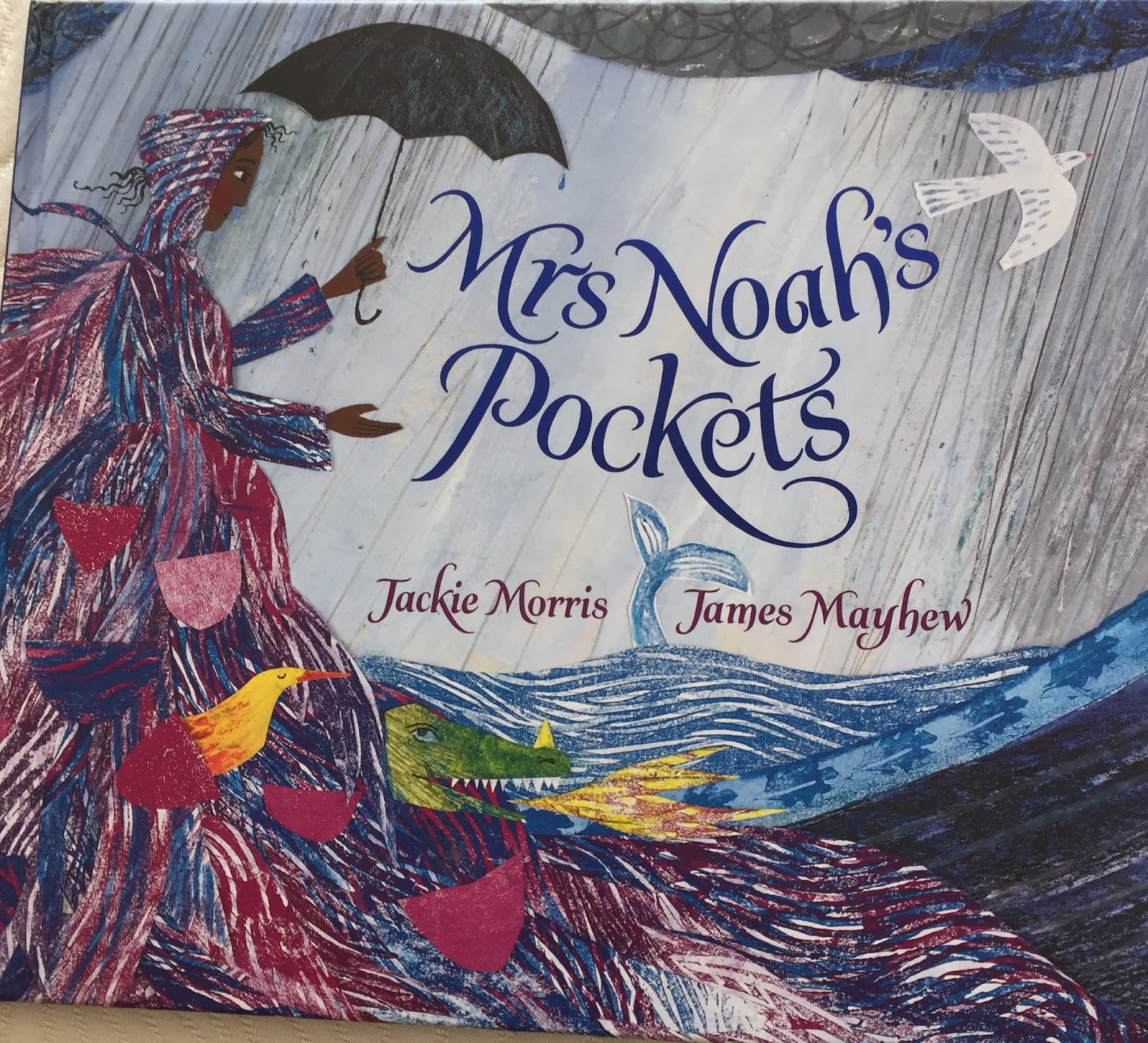
But as soon as I heard about Mrs Noah's Pockets, I was curious and asked for a copy to review. My interest sprang from the fact that this was a book by two people, each of whom is both a writer and an artist. Anyone who knows James Mayhew's work will see at once that this book is a new departure, using collage and great washes of colour. I was struck at once by the vigour and exuberance  of this art work. Morris's words are very spare and poetic without being  cutesy or over lyrical. The text begins : "IT RAINED."  Everything follows from that. The opening spread is so spectacular that I am not showing it. It makes you catch your breath. A washed- out landscape of hills and one tree is being thoroughly soaked. There's a figure in red standing at the top of a hill. That's Mrs Noah.  Mr Noah also sees the water rising and begins building an Ark. This is Bible Story Retelling territory, but appearances can be deceptive...


As her husband deals with the Ark, Mrs Noah has her own  agenda. She goes walking "in Mythico Woods, on errands of her own."


Mr Noah thinks she's making curtains for the Ark when she's busy at her sewing machine, but she says nothing, and when all the animals are safely gathered in, we learn that she has made herself a coat with very, very deep pockets.


By this time, readers are desperate to know WHAT is Mrs Noah up to? What is in those deep pockets?  At night, Mrs Noah tells stories of mythical creatures, such as unicorns, dragons, phoenixes and many others. When they come to land at last and the real animals are released, Mrs. Noah sets free the contents of her magical pockets: all the mythical creatures whose tales she's been telling the children during the Ark's long voyage. The illustrations in this  book are absolutely beautiful and appropriate for the story, which is a masterpiece of economy and imagination. It's also just the right length for anyone looking for a perfect bedtime story. Because it's a book full of marvels, I think MARVELLOUS is the right word to describe it. 

Pub in hardback by Otter-Barry Books at £12.99


THE GLASSMAKER'S DAUGHTER is another delightful story from the team that brought you the glorious ZERAFFA GIRAFFE. This time the setting is Venice. This is a city Jane Ray has often depicted before and it seems to be exactly in tune with her gift for decoration and ornamentation and sumptuous colour. 


The story concerns Daniela, who, in the tradition of many a storybook princess, is miserable, bored and sulky. Her glassmaker father creates a glass palace and promises it  to anyone who can make her smile.  Various people try various methods but nothing works until a young man called Angelo comes up with a brilliant idea...
In this book too, there's a dramatic spread which is a dazzling surprise and of course, by the end Daniela is laughing so happily that the entire city laughs with her.  It's a very satisfying conclusion and looking at the details on every spread will keep young readers satisfied for a long time. Many congratulations to this very engaging partnership!

Published in hardback by Frances Lincoln. £12.99


Return to REVIEWS HOMEPAGE

Monday, 29 August 2016

The One and Only Ivan by Katherine Applegate, reviewed by Sarah Hammond

The One and Only Ivan tells the story of Ivan, a silverback gorilla, who was taken from the wild as an infant to live in captivity in America. It is an intelligent, poignant middle grade fantasy told from Ivan's perspective. The story is heartbreaking and heartwarming by turns.  

When we first meet him, Ivan has been living in a cage in the Exit 8 Big Top Mall and Video Arcade for the last 27 years. He does not seem to remember or miss his life in the jungle. He only has a few friends around him: Stella the elephant-next-door who performs tricks for the crowds; and Bob, a stray dog who sneaks in to see Ivan at night and to sleep on his belly. Ivan occupies his days with his TV and his ‘artwork’, which is sold at the mall gift shop.

One day, to address the falling popularity of the animals and low visitor numbers, a newcomer is brought to the mall: a baby elephant called Ruby. Memories of home are very raw for this little elephant, and Ruby has not yet acclimatised to the human world. In helping her, and in addressing the changes that she brings, Ivan finds himself reassessing his own captivity, too. 

The story is told by Ivan using deceptively simple words and short chapters. As he says, "Humans waste words. They toss them like banana peels and leave them to rot." Long after reading this book, many sentences and images — poignant and poetic in their understatement — stay with me still. We learn that Ivan is patient and thoughtful and resilient and resourceful. Slowly, we discover his harrowing past. A reader warning is due here: it would be difficult to finish this book with a dry eye, and many questions are raised about the treatment of animals in captivity. 

However, the overall message of the book is not downbeat. A strong thread of humanity and tenderness runs through the story. Although Ivan's worldview anchors the book, many other characters contribute to this growing sense of kindness: Stella, the stoic and maternal elephant; the not-as-tough-as-he-seems dog, Bob; sensitive and intuitive Julia who understands Ivan's paintings; lively, questioning, and loving baby Ruby; and George, the caring caretaker of the mall. As Ivan seeks to protect and rescue Ruby from her difficult new environment, he strengthens enough to confront his own buried memories and to rescue his own identity as a silverback in all its glory. 

The author was inspired to write The One and Only Ivan by the story of a real gorilla of the same name who was captured from (what is now) the Democratic Republic of the Congo as an infant, and who lived in a domestic home in America until he became unmanageable. Then he, too, lived alone in a cage for almost three decades without seeing another gorilla in a circus-themed mall in Washington state. Eventually, as attitudes towards animal welfare and understanding of primate needs developed, his plight was given publicity by a feature in the National Geographic, called 'The Urban Gorilla'. This article triggered a public outcry and Ivan eventually found a home in Zoo Atlanta in 1994. There, he became a celebrity, living with the largest group of captive western lowland gorillas in the US. This Ivan was also renowned for his paintings. He died when he was 50 years old. 

ABOUT THE AUTHOR: 
Katherine Applegate won the 2013 Newbery Medal for The One and Only Ivan. She has written many books including the Roscoe Riley Rules chapter book series and the picture book The Buffalo Storm. Her novel Home of the Brave was a School Library Best Book of the Year and won both the Golden Kite Award and the Josette Frank Award for best children's fiction. She wrote the bestselling series Animorphs with her husband, Michael Grant. She lives in Northern California with her husband and their two children.You can find out more about her on her website: www.katherineapplegate.com

ABOUT THE REVIEWER:


Sarah Hammond is a writer for young people. She has published a picture book, Mine! (Parragon), and a teen novel, The Night Sky in my Head (OUP), which was short-listed for four awards in the UK. She is a Brit abroad, now living happily in Chicago, with strong ties to the UK which regularly pull her back across the Pond. 

You can find her online at: 

Web: www.sarahhammond.org
Facebook: SarahHammondAuthorPage
Twitter: @SarahHammond9 


Return to REVIEWS HOMEPAGE

Thursday, 30 June 2016

Ida, Always by Caron Levis and Charles Santoso - reviewed by Sarah Hammond

Ida, Always is a lyrical story about the friendship between two polar bears and how they come to terms with one of the animal’s terminal illness. Although this is difficult subject matter, the reader feels in safe, sure hands. We grow to love the bears, then share their grief and, ultimately, learn to heal. 

Gus and Ida, the two characters in the book, are inspired by polar bears who lived in Central Park Zoo in New York. Ida died in 2011, Gus in 2013.  Author Levis observed Gus in the zoo after Ida’s death as part of her research for the project. 

In the story, the two bears do everything together.  We see life through the senses of a zoo animal, sensitive to sound, to routine, to hearing things we cannot see. One day, Gus learns from the zookeeper that Ida is ill and will not get better.  We are reassured that Ida 'wouldn't hurt’, but her body is closing down. Levis is honest but sensitive, and takes the young reader gently through the anguish of preparing for the loss of a friend. The bears growl, whisper, cuddle, need time apart, even laugh… 

The illustrations by Santoso complement the text well. The portrayal of the bears is not overly anthropomorphised, is evocative, gentle, soft.  The landscape and the weather often reflect the mood of the moment on the page. We have a strong sense of the story world through the illustrations, and also of the way Gus perceives life.

And after Ida has gone (I have to confess that when reading the book aloud, my voice catches each time I read a certain poignant section), and as Gus grieves, his heart begins to mend. He slowly realises that a part of his friend will be with him in the memories they share, that she is with him as he sits in their favourite spots. A part of Ida is with him. Always.

I suspect that this book may well become a classic. 


ABOUT THE AUTHOR:

Caron Levis is the author of the picture book Ida, Always (Atheneum) which the New York Times Book Review calls "an example of children's books at their best." Her first picture book, Stuck with the Blooz (HMH) was selected as one of Bankstreet College's Best Children's Books of the Year. Forthcoming titles include May I Have A Word? (FSG/Macmillan, 2017) and Stop That Yawn (Atheneum, 2018). Short stories have been listed in the Best American Nonrequired Reading, published in Fence Magazine, The New Guard Review, and in anthologies by Persea Books and W.W. Norton. Caron is an adjunct professor and the advisor for The New School's Writing for Children/YA MFA program, and an MSW candidate at Hunter College. After many years as an arts educator, Caron now loves using acting and writing to teach social, emotional and literacy skills to students of all ages through her author workshops. Having trained in acting and dabbled in playwriting, Caron enjoys turning theatre techniques into writing tool through her workshop Act-Like-A-Writer. Visit her at www.caronlevis.com. Photo credit: Jan Carr


ABOUT THE ILLUSTRATOR:

Charles Santoso has illustrated several picture books, including I Don't Like Koala, written by Sean Ferrell, Spy Guy: The Not-So-Secret Agent written by Jessica Young, Peanut Butter & Brains written by Joe McGhee, Ida, Always written by Caron Levis. Find out more about him at www.charlessantoso.com


ABOUT THE REVIEWER: 

Sarah Hammond is a writer for young people. She has published a picture book, Mine! (Parragon), and a teen novel, The Night Sky in my Head (OUP), which was short-listed for four awards in the UK. She is a Brit abroad, now living happily in Chicago, with strong ties to the UK which regularly pull her back across the Pond. 

You can find her online at: 

Web: www.sarahhammond.org
Facebook: SarahHammondAuthorPage
Twitter: @SarahHammond9 


Return to REVIEWS HOMEPAGE