Showing posts with label picture book. Show all posts

Monday, 15 June 2020

CHOCOLATE CAKE by Michael Rosen, illustrated by Kevin Waldron. Review by Penny Dolan.

Hello! Like many, many people, I was happy to hear the good news that MICHAEL ROSEN - poet, writer, educator, former Children's Laureate and general Treasure - has left the intense Coronovirus Unit and is recovering safely and slowly with those he loves.

Good wishes to Michael Rosen and his family from both Awfully Big Adventure Blogs.

Here, through an updated review, is a a reminder of the enjoyment he brings to so many people:


Michael Rosen’s picture book, which was sent to me, is based on one of his most popular spoken poems, available on YouTube.

The subject - chocolate cake! - is one which most children will have strong feelings about, while my viewing of social media suggests that it is probably a favourite daydream for many adults too, especially teachers in need of comfort in the classroom. 

 (Update: And especially right now, as teachers and support staff continue to cope with the current impact of the virus on schools and pupils, with the current state of goverment planning, and all the "media messages".)

The book is already on the way to being a winning idea. 

(Update: It was - and here is a fantastic video of Michael sharing the poem with children in Scotland - a reminder of the joy of school author visits and a hope that one day such events will be possible again!  )


The lively page spreads amplify the narrative structure of the poem. Told in his well-known first person “child” voice, Rosen retells a half-familiar family anecdote: the story of a young boy sneaking downstairs at night while his parents are asleep in bed. The boy knows there is a chocolate cake waiting in the fridge and just wants to look at it. Inevitably, bit by bit, the young narrator nibbles, eats and then gobbles up the entire delicious cake. 

I recall a Naughty Little Sister story where the greedy dish was a birthday tea-party trifle, and this half-familiarity of the incident Rosen uses that gives the story universal appeal. 
Of course, as he goes back to bed, the boy suddenly realises he will be in big trouble. . He decides that the only way to stop his Mum finding out is to remove all the evidence so he spends the rest of the night cleaning away every crumb and clue. Except, of course, he doesn't quite succeed, but you’ll have to read the book or view the poem to find out quite what he's forgotten.

Kevin Waldron, who has been named one of BookTrust’s best new illustrators, brings a welcome child’s-eye view to the pages. His spreads and page-turns dramatise the action, adding to the suspense of the slightly naughty deed done at night in a dark house. 

Waldron uses interesting text layouts and speech bubbles to accentuate the poem’s lively use of sounds - Heh- heh! Gobble-Gulp! -  and all the muttered worries and "instructions to self" – Good thinking! All right, yeah! – so that it’s easy to imagine any young reader being encouraged to join in with the friendly telling. Waldron’s artwork isn’t of the “beautiful” kind but I really liked the way he has captured the young child’s world and viewpoint. 

The picture book format makes the reader – young or old -  both an observer and a sympathetic third party, feeling the tension between the child’s longing, the delicious naughtiness of the greedy theft and the knowledge that he is bound to be found out.

I did not see Rosen’s CHOCOLATE CAKE video beforehand as I wanted this picture book to be a fresh experience. Would it have been different if I’d seen it? I can’t tell. However, as an ex-teacher, I’m sure that the younger readers may well appreciate having both versions of the poem, and that one can help the other along.

Besides, CHOCOLATE CAKE might make a useful book for Key Stage Two classes to borrow. The format, demonstrating the steps of the "plot", could encourage children and teachers to explore their own anecdotal storytelling s, and I’ve also found, on school visits, that Rosen's poems, based on everyday family life, make very good immediate ways in to creative personal writing for KS2 children.

Unfortunately, I suspect that reading CHOCOLATE CAKE might make the whole class and teaching staff long for break time treats! 

Good wishes to all of you who have been keeping children happy in one way or another over these last desperate weeks!

Penny Dolan.


Return to REVIEWS HOMEPAGE

Saturday, 16 May 2020

Tom's Magnificent Machines by Linda Sarah - illustrated by Ben Mantle - reviewed by Damian Harvey

Here's a lovely review from (usually) star school viiting author Damian Harvey, discovered in the archives today. Thank you, Damian. (Ed.)

Seeing this book in the library I thought it was new, thought it's actually been around for a while now. After reading it I thought it was well worth bringing to your attention if, like me, you missed it when it when it was published. 

Tom lives with his dad in a lovely house by the side of a lake. They love making things together, especially things that move. What started with a simple go-kart pulled with string soon moved on to much bigger things and the house is filled with inventions – including a roller coaster with bath tub cars. But most of all, Tom’s dad works hard to ensure that the house is filled with fun and laughter. On the walls we see pictures of Tom’s Mum and Dad graduating, getting married, and holding baby Tom. But other than in the pictures, there’s no Mum to be seen.

When Tom’s Dad loses his job, a change comes over the house and Tom feels that he’s lost his ‘funny, smiling dad.” Things go from bad to worse when Dad announces that they will have to leave their house but Tom is determined to do something. Together they change their house into ‘The Museum of Vehicles Made From Things Not Usually Used For Making Vehicles’ and people come from far and wide to see all of the weird and wonderful inventions that the two have made.
Just when things seem to be getting better, and Dad announces that they can stay in their house, a huge whirlwind strikes and destroys everything. “Why can’t good things ever stay the way they are? Thought Tom.”
But Tom and Dad aren’t about to give up yet as they have one more idea up their sleeves…
 Linda Sarah has written a beautiful story that is full of hope, love, the joy the imagination and the determination to never, ever give up on your dream of happiness. Ben Mantle's detailed artwork perfectly compliments the story and brings it alive.

Reviewed by Damian Harvey

www.damianharvey.co.uk

Twitter @damianjharvey


Return to REVIEWS HOMEPAGE

Thursday, 19 December 2019

Ish by Peter Reynolds, reviewed by Sarah Hammond

Whether you are a child or an adult, who has not been frustrated at some point in time that whatever-you-have-created is not ‘good’ enough? I certainly have. As a creative writing teacher, I have witnessed children making this comment many times about their stories or illustrations, too. 

Here is a suggested solution: read Ish by Peter Reynolds. 

Ish follows the story of Ramon who loves to draw. He draws passionately anytime, anything, anywhere until one day his brother Leon makes fun of his artwork. 

WHAT is THAT?” he asked.

And with that, Ramon’s confidence in his artistic abilities is dented. His inner critic becomes rampant. Nothing he draws is good enough. Nothing looks right. Drawing after drawing is crumpled and thrown to the ground. 

This, I suspect, is an uncomfortably familiar scenario for many creatives the world over. 

Finally, Ramon gives up. 

However, all is not lost. His sister, Marisol, who has been watching from a distance, picks up Ramon’s crumpled drawing and runs away with it. Furious, Ramon chases after her into her room, but then falls silent. This is not the first crumpled drawing that Marisol has retrieved: a whole gallery of his discarded drawings have been saved and pinned to her wall. When she points out her favorite, a vase of flowers, Ramon mutters that it doesn’t look right. Marisol answers: “Well, it looks vase-ISH!” 

And with those words, she releases her brother from his exacting, paralyzing standards, and he begins to see his artwork ‘in a whole new way.’

Ramon felt light and energised. 

Thinking ish-ly allowed his ideas to flow freely.

He began to draw what he felt — loose lines.

Quickly springing out. 

Without worry.

His confidence grows, and he becomes prolific once more in creating ish-drawings, unfettered by the need to get everything ‘just so.’ And he is not even restricted to his artwork but expresses himself ‘ish-ly’ in writing and other forms too. 

This is such a wonderful message to anyone who needs to give themself permission to loosen up, to silence their over-active inner critic, and unburden themselves from the impossible strain of perfectionism. Instead, why not celebrate trying to the capture the essense, or ish-ness, of the world and your experiences? Although the advice in Ish is simple, it is gentle and forgiving and effective and profound.

Ish is part of a trilogy of picture books by Reynolds called Creatrilogy, including The Dot, which encourages us to make a mark and see where it takes us, and Sky Color, which invites the reader to really look at the world around them for inspiration.  


Return to REVIEWS HOMEPAGE

Friday, 25 October 2019

Sparky! by Jenny Offill, illustrated by Chris Appelhans, reviewed by Sarah Hammond

I chuckled many times when reading this offbeat, quirky picture book. Many parents express concerns when their child wants a pet. In Sparky!, the protagonist extracts her mother's promise that she can have any pet as long as it ‘doesn’t need to be walked or bathed or fed.’ 

And where would a child go when researching the solution to such a problem? Answer: her school librarian Mrs. Kinklebaum ‘(who knows everything in the world).’

Fast forward to the arrival of a sloth by Express Mail. 

Sparky is an endearing new family member. Offill makes wry observations about his appearance and the peculiarities of his interactions with his new owner. It takes two days for the sloth to wake up, and when he does:

‘He didn’t know a lot of games, so I taught him some. 
We played King of the Mountain
and I won.
We played Hide-and-Seek
and I won…
We played Statue and Sparky
was very, very good.’

The story builds to its climax as the protagonist tries to show off her new pet’s skills to a skeptical neighbor and the local crossing guard in a Trained Sloth Extravaganza. Sparky is not receptive to the girl’s training sessions and, in the end, while the extravaganza does not go as planned, the protagonist accepts his unique characteristics with humor. 

‘I tagged him on his claw.
“You’re it, Sparky,” I said. 
And for a long, long time he was.’

The story is told in first person, and although we never learn the girl protagonist’s name, we get a strong sense of her character. She shows resilience in finding a suitable pet, works enthusiastically to engage with her sloth, and ultimately enjoys the sleepy companionships he offers. Offhill’s thumbnail descriptions of the other characters are also deft and telling.

For me this is a story about a girl adapting to befriend an unusual character with charm and humor at its heart. There is a distinct atmosphere to the book. The writing is concise and spare, the jokes dry and understated. Chris Appelhans (an artist for animated feature films including Coraline and Fantastic Mr Fox) captures the slow-moving Sparky with similar humor in his illustrations. Sparky does not move a muscle whether up a tree or sitting on the ground. Even his expression remains largely the same.Tellingly, the last illustration shows the girl and her sloth sitting happily side-by-side on a branch, watching the sun set.  


Return to REVIEWS HOMEPAGE

Saturday, 13 July 2019

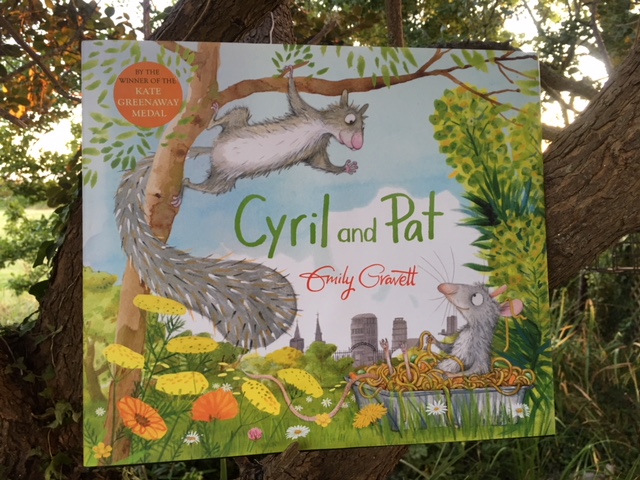
Cyril and Pat, written and illustrated by Emily Gravett, reviewed by Pippa Goodhart

Image result for cyril and pat image
A beauty of a book


Lonely Cyril the squirrel meets a friend called Pat, and Pat's a (spot the difference?)... 

Image result for cyril and pat image
... squirrel as far as Cyril is concerned. Pat's also a brilliant sharer, and a scruffy, naughty FUN friend to scamper around  and make mayhem with ...
Image result for cyril and pat image
... until a small boy tells Cyril that actually Pat isn't a fellow squirrel, he's a ...page turn... RAT! And everyone is telling Cyril not to be friends with such a creature. So Cyril is on his own again, trying to do the same games, but it just isn't fun. And then being alone turns scary ...

Image result for cyril and pat image

...until Pat comes to the rescue, along with a whole pack of rats. And soon Cyril is back with 'his brave and clever best friend, Pat'.


Emily Gravett is a master of rhyme and using page turns to dramatic effect, and, of course, creating beautiful, funny, moving pictures for this story about the importance of staying true to your friends. 
A picture book of the very best sort.


Return to REVIEWS HOMEPAGE

Friday, 5 July 2019

The Book of Mistakes, by Corinna Luyken, reviewed by Sarah Hammond

Some time ago, during one of my Story Explorer Creative Writing workshops for youngsters, a little girl became very frustrated that she could not get her drawing ‘right’, that she kept making 'mistakes’. In fact, she almost ripped through the page with her pencil as she scratched out her illustrations. We worked through the problem, but shortly afterwards I stumbled upon The Book of Mistakes by Corinna Luyken which is the perfect picture book to help in this situation. What an excellent resource to show children that a 'mistake' can actually be the beginning of a whole new set of possibilities. 

The premise of the story is simple: the narrator makes a mistake when drawing a character's face. One eye is bigger than the other. So the narrator tries to fix the problem… and makes it worse. Now the other eye is even bigger than the first eye. BUT, if the too-big-eyes are turned into a pair of glasses, then the character looks even more interesting than in the original drawing. 

The narrator makes more mistakes: the neck is too long, the feet do not touch the ground, a splodge of ink messes up the face. However, with a bit of imagination and creativity, each error develops the story and moves it forward: now the neck is decorated with a beautiful collar, the character is actually wearing roller skates, and the ink blot becomes her hat. 

Some mistakes just do not work out and are disregarded. But in the grand scheme of the other inventions in the book, this does not really matter.  The reader sees that the unfolding story is a work in progress, that it is fun to experiment, to turn one thing into another and see where it takes us. 

After a while, the words in The Book of Mistakes disappear completely. For five straight double-page spreads, the illustrations alone tell the story. Our newly-created girl character moves into a story world, which develops into an adventurous fantasy land of possibility, peopled with children playing around a big tree. 

The perspective for the illustrations now changes, zooms out, so that the tree becomes part of a bigger wood. Then we realize the dark wood is actually on top of a girl’s head (part of her mind?) — a girl that has an uncanny resemblance to the character that was created at the beginning of the book. And now this girl starts to draw a face which reminds us of how the story began… 

We are left with two final questions that address the reader directly: “Do you see how with each mistake she is becoming? Do you see now who she could be?” 

As observed by a child at story time, “Since the girl in the book is the one making the pictures of herself, it’s like she’s the real artist. We’re seeing how the real artist thinks.”


Return to REVIEWS HOMEPAGE

Friday, 10 May 2019

Superbat by Matt Carr, reviewed by Sarah Hammond

Who doesn’t love a good superhero? Who doesn’t love an engaging animal protagonist? I have read this picture book to youngsters in several of my writing workshops and it goes down a treat. Even the title strikes a chord with these audiences. 

In this story, we follow the journey of Pat the bat who cannot sleep because he yearns to be a superhero. Yet even though he makes himself a costume (struggling to keep his wings out the way of his sewing machine), the other bats need more convincing. What are his superpowers exactly? 

Pat has super-hearing! But so do the other bats. Pat can fly! But so can the others. Pat has echolocation! But so do all his bat friends (and, inadvertently, the reader learns what echolocation means). Carr weaves in animal facts and learnings as this issue is debated. For interested readers, there is a section of Batty Facts in the back matter of the book, too.

Dejected, our hero returns home. Perhaps he is no superhero after all. 

Carr injects humour, both for adults and children, throughout the book. The opening sentences are simple but funny (and informative about animal behaviour): It was the middle of the day and Pat the bat could not sleep. He was bored of hanging around in a dark cave.

There are also jokes in Carr’s comic-book style illustrations. Readers enjoy spotting them, such as the slogan picture on the wall that reads Cave Sweet Cave.  

The adult reader also has cause to smile as we hear the commentary of the residents of the city looking up at Pat flying across the skies. Is it a bird?  Is it a plane? Er… I think it’s a BAT in a funny little costume!

However, all is not lost. Suddenly Pat detects a faint cry from the other side of town. Someone is in danger! And now we see a real superhero, rushing to the rescue in a ‘blur of fur’. Pat’s superpower is ultimately, we discover, his courage. The young audiences in my workshops found this ending very satisfying and relatable. As one girl told me afterwards, ‘courage means you do the right thing, even though it’s hard.’


Return to REVIEWS HOMEPAGE

Tuesday, 19 March 2019

Dress Like A Girl by Patricia Toht, illustrated by Lorian Tu-Dean, reviewed by Sarah Hammond

This is an empowering picture book about what it means to dress ‘like a girl’. Perhaps this phrase has had negative or limiting connotations in the past, but not in this story: it is a cause for celebration. As a group of six diverse little girls get together for a sleepover, their imaginative play leads them to dress up. What should they wear? Who should they be? 

Toht chooses second person point of view to address the girls and the reader directly. Her tone is playful and humourous. Adopting phrases from the fashion world, she turns these ideas on their head. Something crisp and white for hot summer days? How about an astronaut’s outfit to take you into space?  Bright vivid hues to make a statement? We see the little girls charging around in red firefighter’s and blue police uniforms. Sleek swimwear? “Slip on some flippers. Explore the seafloor.” 

Notably, the advice is positive, offering suggestions of all the things the girls could choose to be, without telling them what they cannot or should not do. The outfits span many occupations — doctors, adventurers, construction workers, artists, sportswomen…  The emphasis is on self-expression and, if after that long list there is still not quite the thing for you, “then design something new!” 

The illustrations by Lorian Tu-Dean are mixed-media, comprising watercolor, gouache, colored pencil and ink. These images show lively, exuberant, resourceful girls on adventure after adventure, accompanied by their expressive dog. The riot of ideas in the illustrations mirror the text well. 

Dress Like a Girl is an engaging story and is also ideal to show girls what they can be in the vein of recent best-selling titles such as Rosie Revere, Engineer! or She Persisted. After all, it is the person underneath that is most important -- the clothes should be tailored to girls’ dreams. 

"What does it mean to dress like a girl? 
Many will tell you in this big wide world
that there are strict rules that must be addressed,
rules you will need when looking your best.
But when you are given these rules to obey,
the secret is heeding them - in your own way."


Return to REVIEWS HOMEPAGE

Sunday, 18 November 2018

Shadow, by Suzy Lee, and The Wall In The Middle of this Book by Jon Agee, reviewed by Sarah Hammond

I was inspired to review these two books by an outstanding picture book dummy workshop I attended recently, run by Laura Montenegro. The focus of the class was the ‘gutter’ of the picture book. As a general rule, book designers keep images and words well away from the gutter (that is, the inside margin on bound books) so they do not disappear into the crack. However, in these two inventive and original picture books, the gutter is an integral part of the story. 


Shadow, an almost wordless picture book by Suzy Lee, uses it horizontally. With the click of a light switch, we discover a little girl in the attic on the upper page, and below the gutter the shadows of the attic objects are reflected on the lower page. A young reader would have fun matching up each object to its shadow. 


Our protagonist shapes her hands to make a shadow bird on the attic floor. This shadow reflection take on a yellow hue and, through the girl’s imagination, begins to develop a life of its own. The story becomes a celebration of creativity as the shadow world grows richer and richer. The little girl immerses herself in her imaginative play, literally diving into the shadow realm on the lower pages of the book. 

The story ends as it began as the little girl goes down for dinner and, with the click of a light switch, the attic is in darkness once more. Or is it?


By contrast, Jon Agee’s The Wall In The Middle Of This Book, uses the gutter vertically to insert a wall division between pages. A knight on the left page is pleased with this wall as it keeps the scary animals (and, we later discover, an ogre) safely contained on the right page of the book. 


However, the reader begins to notice that all is not as it originally seemed. The scary animals on the right pages appear to be frightened by a mouse, and slowly but surely a body of water with lurking sea monsters is rising up the left pages…

Readers will enjoy spotting these changes and the developing visual stories that unfold on either side of the wall. From an adult perspective, I loved the satisfying conclusion that assumptions about the need for walls, and the ‘bad’ creatures on the other side of them that need containing, might not be correct after all.

Both books encourage readers to engage in a fresh way -- the movement and tension of the stories depend on the physical shape and design of the book. Although for different reasons, both stories celebrate the journey to the page beyond the gutter, to adventure and exploration albeit within the age-appropriate safe realm of a picture book. This makes for a satisfying read on many levels.


Return to REVIEWS HOMEPAGE

Monday, 3 September 2018

A House That Once Was by Julie Fogliano, illustrated by Lane Smith and reviewed by Sarah Hammond

I stumbled on this little gem a few weeks ago. I read it, and read it again. And again. It is a lyrical picture book that somehow seeped into my bones. What is it about? It is a story of two children who stumble upon an abandoned house in the woods. Yet this summary of the subject doesn’t really do it justice. Here is the opening: 

Deep in the woods
is a house
just a house
that once was
but now isn’t 
a home. 

Although there is no punctuation, there is no doubt as to the rhythm of this sentence. The story has a strong voice. We know exactly how to read it out loud. Also, there is a hint of fairy tale — deep in the woods — and a wistfulness in the tension between what is and what was. 

The children get closer, noting evidence of the house’s past and its current state. The house is magnetic and ‘waiting’. Temptingly, the front door is “closed but not quite.” And the window is: 

‘…watching. 
A window that once opened wide. 
A window that now has no window at all. 
A window that says climb inside.” 

Slowly the children start to look for clues. Who lived here? They ask questions in hushed tones, growing bolder as they explore.

It is a story full of wonder and exploration. Empty houses can be sad places and at times there is a sense of loss, of the house waiting for someone to come home. But the author also balances this with humour in the children’s pondering:

‘… were they shipwrecked and now live on an island
wearing coconut clothes with a pineapple tie?’

The children even wonder if the house likes savoring its memories, hidden in the forest, intertwining with nature.

The illustrations by Lane Smith mirror the wistful nature of the story, teasing us with artifacts and possessions around the house of ‘someone who’s gone but is still everywhere’. The present day scenes are made with India ink, drawn on vellum, then pressed onto watercolor paper to create a blotted line effect. However, the illustrations showing the children’s flights of imagination and wonder — such as, ‘was it a man with a  big beard and glasses who would look out the window and dream of the sea?’ — are created using different techniques. They are brighter, more definite and also more whimsical. For these imagined scenes, Smith used oil paint on hot press board and scanned with paper collage elements that were combined digitally. 

As with the artwork, this ostensibly simple story has many layers. It is an adventure. It teases and stimulates the imagination. It also muses on the passage of time, on memory, on change, yet gives a reassuringly comforting ending for its audience. It is also a picture book poem.


Return to REVIEWS HOMEPAGE