Return to REVIEWS HOMEPAGE
Monday, 26 August 2019
In That Time of Secrets by Ann Turnbull reviewed by Adèle Geras
Return to REVIEWS HOMEPAGE
Saturday, 21 October 2017
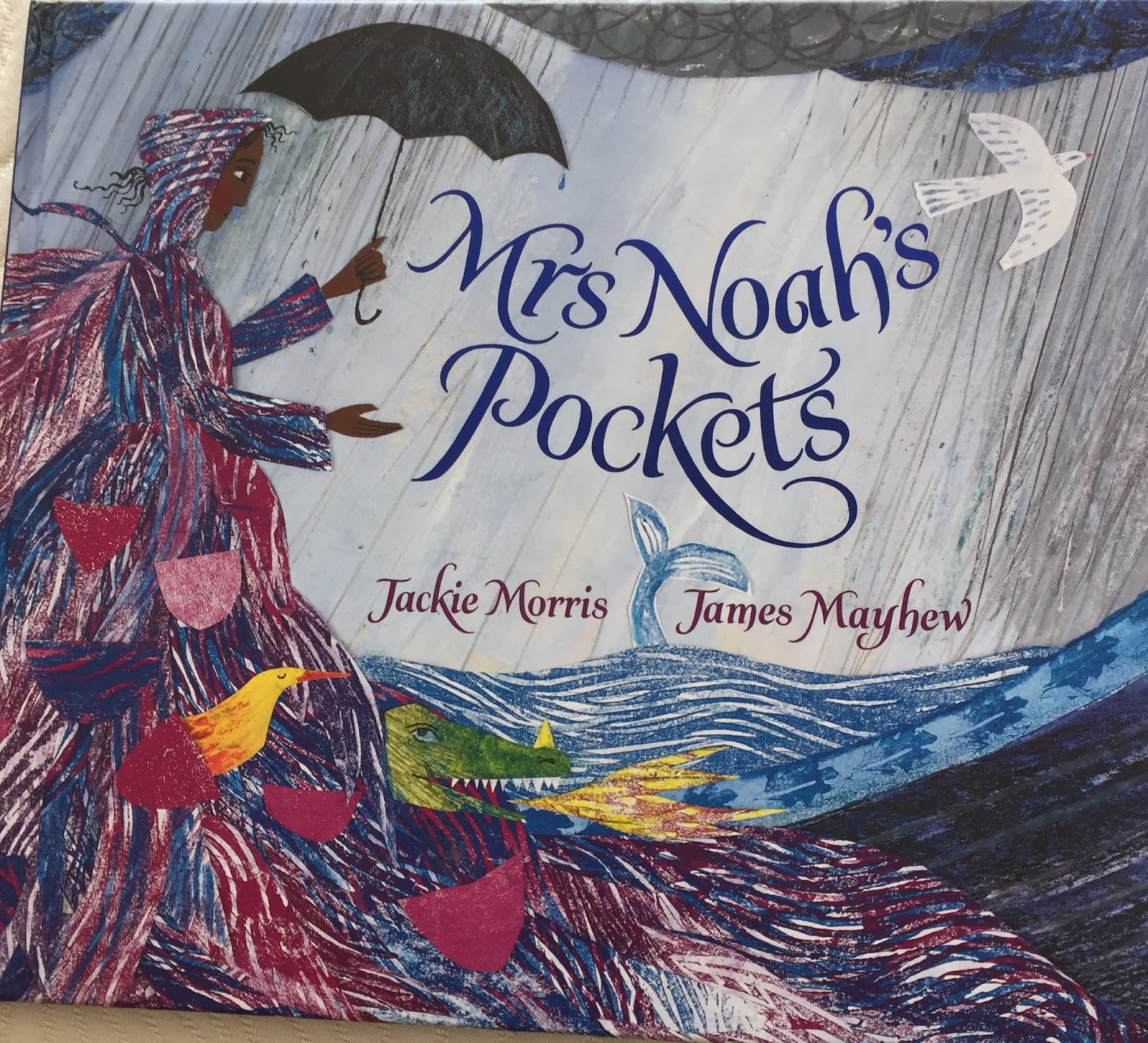
TWO PICTURE BOOKS reviewed by Adèle Geras
As her husband deals with the Ark, Mrs Noah has her own agenda. She goes walking "in Mythico Woods, on errands of her own."
Mr Noah thinks she's making curtains for the Ark when she's busy at her sewing machine, but she says nothing, and when all the animals are safely gathered in, we learn that she has made herself a coat with very, very deep pockets.
By this time, readers are desperate to know WHAT is Mrs Noah up to? What is in those deep pockets? At night, Mrs Noah tells stories of mythical creatures, such as unicorns, dragons, phoenixes and many others. When they come to land at last and the real animals are released, Mrs. Noah sets free the contents of her magical pockets: all the mythical creatures whose tales she's been telling the children during the Ark's long voyage. The illustrations in this book are absolutely beautiful and appropriate for the story, which is a masterpiece of economy and imagination. It's also just the right length for anyone looking for a perfect bedtime story. Because it's a book full of marvels, I think MARVELLOUS is the right word to describe it.
Pub in hardback by Otter-Barry Books at £12.99
THE GLASSMAKER'S DAUGHTER is another delightful story from the team that brought you the glorious ZERAFFA GIRAFFE. This time the setting is Venice. This is a city Jane Ray has often depicted before and it seems to be exactly in tune with her gift for decoration and ornamentation and sumptuous colour.
The story concerns Daniela, who, in the tradition of many a storybook princess, is miserable, bored and sulky. Her glassmaker father creates a glass palace and promises it to anyone who can make her smile. Various people try various methods but nothing works until a young man called Angelo comes up with a brilliant idea...
In this book too, there's a dramatic spread which is a dazzling surprise and of course, by the end Daniela is laughing so happily that the entire city laughs with her. It's a very satisfying conclusion and looking at the details on every spread will keep young readers satisfied for a long time. Many congratulations to this very engaging partnership!
Published in hardback by Frances Lincoln. £12.99
Return to REVIEWS HOMEPAGE
Sunday, 2 July 2017
ONCE UPON AN ABC by Sophie Masson/Christopher Nielsen Reviewed by Adèle Geras
and for every letter, a picture of a character from world folk and fairy tale. Below is a mermaid, whom I particularly like because she seems to be advertising Shell Petrol!
The text rhymes with great cleverness and there isn't a child who won't enjoy speaking it aloud with its parents and who will soon have it entirely by heart. You've seen some of the pictures. They're beautiful: strong and modern and printed in unusually subtle shades of every colour. It's a winner, this book and I do hope many reception teachers as well as parents will try and get hold of it. In these days of the internet, it shouldn't be a problem buying it from Australia. The publisher's website address is below. And maybe, who knows, there's a British publisher who will step up and make it available here.
ISBN:9781760128432
www.littleharebooks.com
Return to REVIEWS HOMEPAGE
Friday, 22 January 2016
THE ICARUS SHOW by Sally Christie Reviewed by Adèle Geras
The story is about a boy, Alex, and his problems and the way he deals with them but it's also about much more than that. It shows that even the most ordinary lives can be transformed: by unexpected events and people with whom on the face of it you have little in common.
Alex has adopted a strategy to avoid being bullied and picked on at school. He lies low and does not react - not to anything. This is presented to us matter-of-factly: it's what you have to do to get by each day, but when the reader pauses to think, it's a heartbreaking way for a young boy to spend his entire school day. His 'trust no one' policy means, of course, that he has no friends. He used to have a friend, who's moved to another part of the country. A boy called Dave Marsh, known as Bogsy, lives in the house next door, but Alex misses his old neighbours, Maisie and Don, an elderly couple. When Don died, Maisie, who was like a granny to Alex, went to live in a care home called The Laurels. Their son, also called Don, lives in Australia.
Then one day Alex finds a feather in his schoolbag and a note saying "A boy is going to fly. Will you be there?" At first, he thinks he's the only one to get such a message but he later discovers that others have had it too, and he sets out to find out who wrote it and even more importantly to wonder: will it happen? Were such things possible? Would a boy fly? And what would be the consequences if he did?
Alex visits Maisie every Saturday. She has Parkinson's and is sometimes confused but he enjoys talking to her and she still has decided opinions about everything.
Then he discovers that Bogsy is making a pair of wings in the shed next door. Alex recognises the feathers he's using and the two boys form a relationship as they work on the wings together, and and it's this strange friendship that colours the second half of the book.
I'm not going to spoil the story by telling you any more. You will have to read it to find out about the flying: about how the wings will be used, and especially about how Alex's whole outlook on life is changed by the Icarus Show.
The book is brilliantly written. Alex tells the story and he's a sympathetic narrator, and uses simple language very effectively to take us into the classroom, the care home, and especially Bogsy's shed, which becomes a kind of workshop for a modern day Daedalus.
The Icarus Show tells us, subtly and without raising its voice, about the way depression works, the things that bullies do and perhaps something of why they do them, how quite troubled children can react to their circumstances and the extent to which unhappiness can be hidden or twisted into many different shapes. It also emphasises the importance of communication: between friends, between members of a family and especially between one generation and another.
Full disclosure: Sally Christie is a friend, but you will have to believe me when I say, (I've said this in almost every review I've written for this website) that I wouldn't recommend something I didn't love. I loved this book, and I'm sure that many, many readers are going to agree with me.
Published in hardback by David Fickling Books £10.99
ISBN: 9781910200483
Return to REVIEWS HOMEPAGE
Tuesday, 20 October 2015
Out of the Dark, by Adele Geras. Reviewed by Saviour Pirotta
Publication Year: 2015
ISBN: 978-1784291259
I have to admit that I am a big fan of Adele Geras' work. My Grandmother's Stories and Voyage are wonderful reads that prove diversity and 'issue' books can be just as entertaining as fantasy or adventure. Troy and Ithaka are superb YA novels that stay true to the essence and feel of the ancient world but still manage to be relevant to twenty first century readers.
I have yet to tackle her full length adult novels so Out of the Dark, a short novella in the QuickReads 2015 series, was a perfect introduction to this side of her work . It is the story of Rob Stone, a young Londonder who has it all: matinee idol looks, a gorgeous girlfriend and a job in a fashionable store where he is much admired by the ladies. World War I robs him of all these. He returns from the battlefields with a burnt face that has to be hidden behind a mask, a girlfriend who very quickly becomes an ex and no job. He does not come home alone. With him comes the ghost of his dead captain, whose Bible and family photograph, Rob has lifted from his pack.
As the young man tries to rebuild his life, and to track down the captain's family, he finds frequent refuge in the darkness of the cinema. I can't say much more without spoiling the ending but let me assure you that this if a first rate read. It's part ghost story, part historical drama. I highly recommended it.
Follow me on twitter @spirotta
Like me on facebook https://www.facebook.com/spirotta
Website http://www.spirotta.com
Return to REVIEWS HOMEPAGE
Sunday, 6 September 2015
MOUSE IN THE HOUSE by Gillian McClure reviewed by Adèle Geras
ahead of its publication this month, and it's a perfect
example of the kind of book which gets overlooked very
often in review roundups and the like.
can't start reading books of this kind to a baby too early.
It's true that at first, (maybe at six months or so) the
subtlety and real meaning of the story will be lost on the
infant, but what the child will pick up on is the rhythm
of the reader's voice, their encircling arms, and the parade
of lovely colours as the pages are turned. Parents ought to be
encouraged to read to children practically from birth, so that this pleasure is absorbed as one of the Good Things, like milk
and food.
has used her own grandchild's cuddly mouse toy as
an inspiration. She's located the story in his house, which
has a squirrel in a tree outside, just like the squirrel in
the story. Not every child has a writer/illustrator as
a granny, but parents and grandparents everywhere will
seize on this delightful tale and make it part of their
repertoire.
sees the mouse. The squirrel hears the mouse. The dog
smells the mouse and the cat touches the mouse. The
baby, of course, simply loves the mouse. It's very simple
and effective. The pictures are pastel crayon, I think,
that gives the book a wonderfully intimate feel.
The colours and lines of the pictures are perfect:
bright but not garish: ever so slightly blurry.
I particularly like the 'mouse' endpapers.
It's a very welcoming story and would make a wonderful
present to take as a present for new parents.
Plaister Press Ltd
9 Trafalgar Street,
Cambridge
CB4 1T
www.plaisterpress.com
Return to REVIEWS HOMEPAGE
Wednesday, 1 January 2014
BELLMAN AND BLACK by DIANE SETTERFIELD, reviewed by Adele Geras.
Happy New Year, and welcome back to the Awfully Big Blog Adventure Review page.
We're welcoming in 2014 with another review by Adele Geras.
This time the book is BELLMAN AND BLACK by Diane Setterfield, a historical novel for adults. The review first appeared in THE VIRTUAL VICTORIAN, author Essie Fox's fascinating history blog, which is well worth a visit .
A dramatised version of Diane Setterfield's first novel, THE THIRTEENTH TALE, was shown on tv over the Christmas period, and might be ideal catch-up-tv for grown-up viewing on a lazy grey day like today, the first of January.
I have been
haunted by it since I read it for the first time some weeks ago. I don't often
reread books. There are too many new and exciting things being published all the
time for me to want to go back to something I already know.Return to REVIEWS HOMEPAGE
Thursday, 19 December 2013
HAPPY CHRISTMAS and THE COMPANY OF GHOSTS by Berlie Doherty, reviewed by Adele Geras.
Meanwhile, from Adele Geras . . .
This would be bad enough, but of course, we know from the title that Ellie is not alone…..there is the ghost. The way Doherty introduces this spectre, the way the supernatural is interwoven with the natural is both spine chilling and lyrical. She specializes in wonderful descriptions of nature and in this case, because our heroine is an artistic child, of her paintings as well. Ellie writes letters to her father, who, in her opinion, has deserted her family to go off to Cornwall on his own leaving her mother to marry someone else and these letters, interspersed with what’s happening on the mainland to George, Morag’s brother, who, through no fault of his own, has failed to arrange Ellie’s rescue, both ease the tension on the island and also rachet it up a few notches as the novel progresses.
This is a book full of moments of really creepy suspense and I’d recommend it to anyone who wants something both unusual and romantic and set in a landscape which is at the same time threatening and very beautiful. It’s a well-written, intriguing and often genuinely scary story, just right for Christmas.
Return to REVIEWS HOMEPAGE
Friday, 26 April 2013
Rafi Brown and the Candy Floss Kid by Sue Stern. Reviewed by Adèle Geras
Once again, I have to start a review with the admission that I know the writer of this book. In fact, I feel as though I'm a kind of godmother to the story, as Sue showed me an early version ages ago and I liked it then. I like it even better now in its new manifestation as a well-produced paperback with excellent illustrations by Heather Dickinson and I applaud Sue's decision to publish the book herself and try and get it to as many children as possible. I'm happy to help in this process as I think there are lots of boys, especially, out there who would both identify with and enjoy this book.
It's about what happens when Rafi, (who has problems with reading and writing and even worse problems with his teacher Horrible Hegarty) meets a girl in the park. She has pink hair and she's the Candy Floss Kid. She shakes up Rafi's thoughts and opinions about everything. She has even worse problems than Rafi, and the two of them have a series of adventures which not only take them round various parts of Manchester (all of which was very nostalgic for me!) but also teach them much about subjects as disparate as the Russian Revolution, cartoons,voodoo, and the way the Social Services work.
Stern is good at dialogue. The boys and girls you'll meet here sound normal and unbookish. She's also good at conveying the many different relationships that exist in young people's lives: with parents, siblings, teachers, friends, enemies and so forth. The place comes to life very well and I can vouch for the accuracy of many of the descriptions, especially that of the park where Rafi and the Candy Floss Kid meet. The horrible teacher is well done and we get a reason for her horribleness towards the end of the book which doesn't quite excuse the way she acts towards Rafi but which at least explains it.
I think this would be a good addition to any school bookshelf and I would urge anyone who has what's called "a reluctant reader' in their family to buy it too. It's enjoyable, well-written, entertaining and about serious things that matter. I'm happy to be able to recommend it in this review.
Published in paperback by RED BANK BOOKS. From Amazon or from the publisher (80 Fog Lane, Didsbury, Manchester M20 6AG)
Price: £5.99
ISBN: 9780957400
The book is also available on Kindle.
Return to REVIEWS HOMEPAGE
Monday, 12 November 2012
THE WINTER OF OUR DISCONNECT by Susan Maushart. Reviewed by Adèle Geras
This book was lent to me by Yvonne Coppard, a member of the SAS whom a great many of the readers of this blog will know. She said it was funny and interesting and she was quite right. I thought it worth drawing to the attention of ABBA readers because it addresses a problem that a great many people share. The author, an American by birth but a longtime resident of Perth, Western Australia, tells the story of a six-month period when she pulled the plug, as she puts it, on Ipods, Iphones, laptops, computers, games consoles etc....everything that connected her children and herself to the world of the Internet.
Inspired by Thoreau's On Walden Pond she took a decision to go 'screen-free' as an experiment. To see if she, a very wired journalist, and her three teenage children, could survive without the help of the World Wide Web. The short answer is: they could and they did. The long answer is the book itself, which is full of careful research into the effects of being plugged in to such things as Facebook, Twitter IMS etc as well as an account of the daily lives of this family and how they reacted, individually and collectively to being without their precious devices.
If that makes it sound dry and dusty and boring, nothing could be further from the truth. It's a hilarious read at times and Maushart has a wonderful way of turning a witty sentence. She describes a world where everyone is so hooked on their phones, Blackberries etc that the real world has practically disappeared. And Maushart is as bad as her children. Away from her home in the USA, she still, after many years, feels not quite at home in Australia and the internet brought her nearer to people and places she longed for. The family was still able to access the internet at school or college or a cafe... just not at home.
To say the changes wrought in the teenaagers were miraculous would be putting it a bit strongly but the progress she charts in each of her children is amazing. The changes are brought on by having to deal with BOREDOM. It's a salutory lesson to all parents, I think, that being bored and learning how to deal with it leads often to great creativity. We are all, she says, too anxious to ensure that every minute of our children's lives are full of things to do. Maushart's son, for example, moved from being someone who barely exchanged a word with his family and stared at a screen for hours in a day to becoming a whizz on the saxophone and a Haruki Murakami completist. Do give yourselves a treat and read this book. It may very well change your life. The message, though, is one of the oldest in the world: everything in moderation.
Published in hardback by Profile Books. Price: £11.99 ISBN:9781846684647Return to REVIEWS HOMEPAGE
Saturday, 3 November 2012
MY WISHES FOR YOU - A Picture Book by Adele Geras, illustrated by Cliff Wright. Review by Pauline Chandler
Return to REVIEWS HOMEPAGE
Sunday, 7 October 2012
MEMORIES IN A HOUSE by Lucy Boston. Reviewed by Adèle Geras
I bought a book called MEMORIES shortly after visiting the Manor. It's a handsome volume, published by Oldknow Books, an imprint set up by Lucy Boston's family and estate. This contains two memoirs: Perverse and Foolish which speaks of Boston's childhood and youth and Memories of a House which is about the Manor, and the life this most intelligent and interesting of writers lived in it. It speaks of how she restored it, how she made the garden, how the whole fabric of what we see today was put together over years.
The book has an excellent introduction by Jill Paton-Walsh, another highly intelligent and sensitive writer who was a friend of Lucy Boston's. It's good to have the personal view and it adds to what Boston herself has revealed to us. She is a somewhat guarded writer and clearly a modest and unassuming person. For instance, for me and for thousands of visitors to the house, the patchworks which Boston made over the decades are one of the main attractions. These and how she came to create them; how they fitted into the almost constant work of restoration of the house, to say nothing of the writing of the novels, are not mentioned. To anyone who didn't know about them, Lucy Boston's own words would not provide any hint of their beauty and originality.
What strikes a reader is the clear sound of Lucy Boston's shrewd and elegant words. It's quite spooky (and the Manor is the most haunted of houses) how clearly her voice comes through the text, almost as though she were speaking to you. It's like an audio book without the audio. She's fearless, sensible, practical and yet very aware of strange vibes in the atmosphere. Reading between the lines, the villagers of Hemingford Grey were not kind to her during the Second World War. Lucy Boston wore an Austrian dirndl skirt for comfort and ease and this was regarded as most suspicious. Perhaps she was a German spy!
It's hard to pick out favourite things from a book like this. There were many sentences I felt like underlining. For example: Very small cracks in our outer shell of reason let in very cold air. The most moving part of the book is the account Boston gives of many musical evenings she used to host in the Manor at which the young airmen from a nearby station would come and sit on cushions and listen to every sort of record on a huge machine which you can see in my post at the top of this review. I also loved her thoughts about the roses in her garden, because I am mad about roses and she speaks so wonderfully about them. Also, for any children's writers, her account of going to collect the 1961 Carnegie medal (for A Stranger at Green Knowe ) is quite hilarious and quite ferocious in its merciless skewering of those who in those days as often today, put children's books on an altogether lower plane of achievement.
You are not going to find this beautifully-produced book in Waterstone's or WHSmith's. You won't even find it in independent bookshops. You have to write to Diana Boston, Lucy's daughter-in-law, who now lives in the Manor and still shows visitors round herself. The house is well worth a visit but even if you have no intention of doing that, treat yourself to something that will be a joy forever. The ISBN is: 095232332X . It's not expensive. £17.00 won't buy you much that's as lasting and pleasurable as these words. Send a cheque to Diana Boston at The Manor, Hemingford Grey, Cambridgeshire, PE28 9BN. The telephone number is: 01480 - 463134. The website is:
http://www.greenknowe.co.uk/
Return to REVIEWS HOMEPAGE
Saturday, 1 September 2012
ARABESQUE by Colin Mulhern. Reviewed by Adèle Geras
This novel is a Young Adult crime novel. It's a genre that's reaching more and more readers, thanks to pioneers in the field like Anne Cassidy and Celia Rees. I'm delighted that it should be so, because I love any kind of mystery, from the traditional detective story to the more gritty stuff that takes you into the heart of a crime in ways that Agatha Christie would never have considered. It's true, I think, that any young person of say, 14 and above who has developed a taste for this sort of book will be reading a great deal of adult crime fiction but that's no reason for writers such as Mulhern to desist. In fact, a book such as 'Arabesque' is probably a good way to get slightly younger teenagers hooked on the genre and once addicted, they can then go on to all sorts of other, more challenging territory.
This book has two qualities which make it ideal for the purpose. It has great readability and once you begin, it's hard to lay the story aside. It concerns two young girls who are promising gymnasts. Amy May in particular is clearly the stuff of which champions are made. But she and her friend Mia are kidnapped and held separately from one another. We follow the adventures of each girl in turn. Mia ends up in a rather unusual kind of brothel (but descriptions around this are never too explicit) and Amy May is in the belly of the beast, so to speak, with the ringleader of the whole kidnap and his gang.
It would be wrong to give you more details of the plot, but I will say that it twists and turns most satisfactorily all the way to the end, which comes out of the blue and is a huge shock, to say the least! I recommend this book to anyone who likes a fast-moving, involving, and exciting read. The best thing about it is: we like and sympathise with the main characters and we care what happens to them. I really enjoyed reading Arabesque and I just hope the appropriate but rather balletic title and the moody picture of a girl on the front cover won't put off the boys too much. They would like it too.
Publisher: CATNIP books. Pbk.£6.99 ISBN 9781846471483Return to REVIEWS HOMEPAGE
Saturday, 21 July 2012
THE QUEEN'S SPY and THE VELVET THIEF by Sally Prue. Reviewed by Adèle Geras.
I'm going to begin this review with an anecdote, but bear with me. In 1994, I published two books in a Longman's reading scheme called The Book Project . Each book contained two poems about cats. They were called 'JOSEPHINE AND POBBLE' and 'MIMI AND APRICOT MAX' and telling these feline stories in verse was some of the most enjoyable writing I've ever done. I was also proud of the poems as poems...there, I've said it. I don't know how many writers will admit to liking their own books, but I'm happy to do so and I think, moreover, that there's a great deal of false modesty about and that most people are actually quite pleased with their own work.
The fact that the books appeared in an educational series meant that no one reviewed them. Not many people know about them, and yet I worked as hard on them as I did on my non-educational books. I think that many writers write very well for publishers whose books are not to be found in most shops, and they therefore have their light hidden, perforce, under a bushel, when it ought to be shining out all over the place.
Next, an admission. Sally Prue, the writer, is a friend of mine. We children's writers are a gregarious lot and I know an awful lot of people whose work I honestly admire and if I were to confine myself to reviewing books by strangers, I'd have very little to write about. And I do want to write about these two books, not because they're by her but because they put paid to the perception that all reading scheme books are boring/unreadable/unstretching of the imagination etc. Pearson in this case, just like Longman's in my case, have had the good idea of asking a real writer to write a proper book for those who still find long, difficult texts a little daunting. These two short stories are part of the very popular Bug Club which teachers will maybe know about but which very few ordinary readers will have come across. The wonderful Love Reading 4Kids website highlights them and I do recommend their site as being a repository of all kinds of good things.
This is a rather long preamble to a discussion of the two stories. They are linked, although each of them can be read alone. They are - and perhaps I ought to have said this before I said anything else - proper historical stories, set at the time of the first Elizabeth and concerning young Edward, son of a glover (yes, just like Shakespeare, for anyone who cares to make the connection) and brother of the indomitable Bridget. He has a Great Aunt Anne and a father and he meets Ned Cobbley in the first book of the two, THE QUEEN'S SPY. Ned Cobbley is a goodie. He looks as though he ought to be a baddie but he isn't. He's funny, and crude and helps Edward in all sorts of ways. The story in this first book revolves around the downfall of a nasty teacher and it's full of humour, good sense, and fun. It's also (and this is the main thing) historically accurate and full of wonderful writing that's elegant without being fussy; humorous without being silly and altogether leads the young reader easily through a story that's so much fun she won't realize how much she's learned about Elizabethan customs and history by the end of the story.THE VELVET THIEF starts in a a way that will appeal to any lovers of lavatorial humour: with Ned Cobbley cleaning out the jakes. Did you know that this was a word for the pit by the side of a house which caught the toilet droppings? You do now! Great Aunt Anne appears for a visit accompanied by Giles Pettit, who is briliantly named. You just know he's not what he seems and his unmasking by Edward, with help from Ned, is delightful. Along the way there are many incidental pleasures in these books. They are full of slapstick, of people falling over, getting wet, and generally landing in uncomfortable situations but throughout the language is fast and unfussy. While not being in the least 'pish-tushy', the words convey clearly a time that isn't our own. These books could easily lead to more children resding historical fiction, and that's surely a good thing. It's hard to imagine anyone not enjoying these books and if I can get them into the hands of a few more children, then I'll be very pleased.
THE QUEEN'S SPY illustrated by Alan Marks. Pearson Bug Club pbk. (no price printed. Order from myorders@pearson.com) ISBN: 9780435076207
THE VELVET THIEF illustrated by Alan Marks Pearson Bug Club pbk as above IBN: 9780435076252
Return to REVIEWS HOMEPAGE
Thursday, 19 July 2012
"It's Time For Bed" and "My Ballet Dreams" by Adele Geras. Review by Penny Dolan
The first book “It’s Time
For Bed” is a comforting, settle-down-to-sleep sort of story, written by Adele
Geras and illustrated in by Sophy Williams.
The second picture book
“My Ballet Dream” has an entirely different mood and look. It feels perfect for sharing with a
young girl beginning her first ballet lessons. Return to REVIEWS HOMEPAGE
Thursday, 26 April 2012
0.4 by Mike Lancaster Reviewed by Adèle Geras
Newspapers and websites and social networking sites are crowded with noise about such things as the HUNGER GAMES trilogy. There are flashy dystopias and science fiction books tied into films all over the place. This book has found its way, through the votes of young people in Lancashire, onto a prize shortlist but it's so enjoyable and has come out with so little fanfare (I'd never even seen it before it appeared on the shortlist) that I feel like drawing it to the attention of everyone.
I am not an SF fan and I'm not keen on fantasy either, for the most part, but this book is an accomplished debut novel and something that I'm sure a lot of boys as well as girls would enjoy.It's set in a future time and the whole story is presented as the findings of/research notes of an Editor. This Editor presents the contents of tapes made in the past. The past is our present and in the account given on them, a boy called Kyle Straker tells us what happens on one day when a friend of his hypnotizes four people as an 'act' in a local talent contest. The contest is an annual event taking place in a small Cambridgeshire village. The whole population of the place turns out to the Village Green to watch. Then something happens...
What follows is both scary and convincing and the idea behind this book is so terrific that I'm not going to say a single word about it. Suffice it to say that the title, 0.4, which at first I thought a bit silly and not very memorable, is EXACTLY right for the narrrative. The cover image too, which is hard to look at without squirming or flinching, is precisely true and horrifying.
I for my part was happy not to be snarled up as I often am when reading SF, in stuff I couldn't understand to save my life. It's a pleasure to read something so well, and clearly and modestly written. The novel has a very clever structure and fits together like good clockwork. The characters are believable and Kyle's voice is one that we like and can listen to for the length of the story. Do yourself a favour. If you have a young person of about 12 or older, buy this for them and read it yourself too!
Publisher: EGMONT Format: Paperback Price: £6.99 ISBN: 9781405253048
Return to REVIEWS HOMEPAGE
Thursday, 22 March 2012
TWO HISTORICAL NOVELS reviewed by Adèle Geras.

The Young Elizabeth 1: TRAITOR’S KISS by Pauline Francis. Usborne pbk £5.99
ISBN: 9781409527411
In an Author’s Note at the end of this short novel, Pauline Francis writes: “I have exploited Elizabeth’s documented character to the full,” and all the readers who have followed the story of the young Princess through times of great danger will be even more impressed with this book. Francis writes very convincingly in the young Elizabeth’s voice. The book begins with a terrifying situation for the Princess on the morning of January 21st, 1549 and we are then taken back one year, to her fourteenth birthday. In the year that we’re going to live through, we meet villains and heroes, friends and enemies, and over the whole hovers the shade of Anne Boleyn, Elizabeth’s mother, whom she loves and whose fate she dreads. She says: I was only two when my father, the king, executed my mother, Anne Boleyn. People say she was a witch who stole his heart with her dark enchantments, but I can remember nothing of her. Yet still the malicious rumours of others haunt me. The whole story revolves around the young Elizabeth learning more about her mother and how true the hideous stories about her really are.
We have the advantage of knowing that she escaped Anne Boleyn's fate to become our most charismatic Queen, but still, there is suspense and tension and that’s down to Pauline Francis’s organization of her material. She’s very good at the detail of Elizabeth’s life: her love of pretty things, of perfume, of sweet things and something else that comes across well is the contrast between the opulence and ease of the palaces in which Elizabeth lives and the squalor, stench and poverty of places like Bedlam, which she visits on one memorable May night.
The supporting characters, Elizabeth’s servants, Francis, the boy who fishes corpses from the river but is Henry VIII’s illegitimate son, the horrible Thomas Seymour, Mary, her half-sister and the daughter of Catherine of Aragon and her friend Robert Dudley, come alive in the pages of this book and we can identify with Elizabeth as she negotiates her way through the network of allegiances and enmities of the Royal court.
This is the perfect book for anyone who loves a good historical novel. You can be sure of the facts and the imagination of the writer has made even more exciting a very exciting period. Usborne have published this book most beautifully, and even the young woman on the cover looks as though she might grow up, if not into Elizabeth herself, then at least into Cate Blanchett. They’ve provided a lot of information for budding historians at the back of the book about where they can find out even more about the Virgin Queen. There’s a good bibliography, (which I assume is the author’s) and this will certainly lead some readers on to further study. They might start with RAVEN QUEEN, (Francis’s previous novel and also very good) which is based on the life of Lady Jane Grey. Highly recommended for private reading and a good resource, also, for school bookshelves.

THE COURT PAINTER’S APPRENTICE by Richard Knight. Catnip pbk. £5.99
ISBN: 9781846471278
This has a very intriguing and period-appropriate cover of part of a young man's face. You'd be well-advised to look more closely at the pupil of his eye... I won't say more but it hints at something in the story you're about to read. This concerns Johann who is supernaturally talented and I use the word advisedly. Not only is he gifted as an artist but his brushstrokes can affect the future in mysterious ways. What he depicts often turns out to be true in the end.
Johann is fourteen and working in his father's inn at the beginning of the novel, drawing to amuse himself. Hugo, a master painter of the Painters' Guild in Ghent, sees Johann's work and recognises his talent. Hugo takes the boy under his wing and almost adopts him. Johann goes to live in Hugo's studio and learns his craft there. While he's doing so, we are given some detail of life in Ghent in the 17th century, and also shown round some existing masterpieces by Jan van Eyck, including the Arnolfini Marriage and the Altarpiece in the church of St Bavo.
The kind-hearted apprentice does his best to make the people he paints happy and subtly alters their fates by doing so. Hugo goes blind as he ages and when Johann paints a self portrait he at last learns to heed his master's advice: "Paint what you see, not what you want to see."
The style is plain and spare and the story moves along at a good pace. We're never too weighed down with detail. Perhaps we could have had more development of the various relationships in the novel and the whole thing could have done with being somewhat longer but that's not going to worry any children reading it. A very promising debut and Richard Knight writes well.
Return to REVIEWS HOMEPAGE