Showing posts with label Adult. Show all posts

Saturday, 28 January 2017

FINGERS IN THE SPARKLE JAR by Chris Packham: reviewed by Sue Purkiss

This isn't a book for children; it's a memoir of what it was like to be a child.

Chris Packham is well-known as a presenter of natural history programmes, notably Springwatch and Autumnwatch. He writes about his childhood in the sixties and early seventies. His story has obvious echoes of Barry Hines' famous book, Kes, about a working class boy who catches and trains a kestrel. Like Billy, Chris as a boy has a profound empathy with the natural world. In Kes there's a bit where Billy describes the sensation of putting his foot into a welly full of tadpoles - the boy Chris does some very similar things: the 'sparkle jar' incident of the title has something in common with that incident.

But this isn't a book 'like' Kes. In fact, it's not a book like any other I've ever read. It is a series of memories, not related chronologically, interspersed with accounts of sessions with a psychiatrist/psychologist whom Chris saw ten or so years ago, when he was suffering from a crippling episode of repression. I don't know how he managed to write in so much detail about these sessions - how did he remember everything they talked about? Or is it an approximation of what they said - a way of exploring his inner being, rather than an accurate representation of what was said? Whatever - these sections cast a light on his
memories of his childhood, and vice versa.

There's just as much detail in his memories of his parents, his early encounters with nature - and of how bewildering it was to be a child who had a different way of relating to the world than most. It's fascinating, and forensically honest.

The writing is extraordinary, rich and lyrical and full of a 'passionate intensity', to lift from Yeats, who, like Bruce Springsteen and Shakespeare, seems to provide a quote for almost every occasion. Here, for example, is his summation of an incident where he came across a cloud of moths in a wood.

Without the restless insects the place seemed stunned, stupefied, shocked by that ballet of gossamer violence, the wonder of plain and simple things drawn together to conjure such beauty, transforming that bubble of urban air into a theatre where an astonishing performance was fleetingly played to an awed audience of one, the memory of which would sparkle for a lifetime. And he knew it then, in that moment of dazed happiness, what a gift, what a thing he had seen, what a treasure he held.

It's not the easiest of reads, but it is immensely rewarding, on several different levels: notably in its minute and loving observation of the natural world - but also in its evocation of the world of a sensitive, driven, bemused boy who finds it much easier to relate to creatures than to human beings.


A version of this review has appeared on my own (mostly) reviewing blog. A Fool On A Hill.

Return to REVIEWS HOMEPAGE

Tuesday, 19 April 2016

BROKEN SKY by Lee Weatherly: reviewed by Gillian Philip


"Everyone has to believe in something," says Amity Vancour's little brother, Hal. He means, of course, that people need to believe; but as it turns out, an awful lot of people love to believe in something. What Hal has not yet seen, at the quarter-point in this chilling novel, is a population persuaded with alarming ease to believe willingly, gladly, joyfully in something entirely irrational. 

I say 'chilling', but L.A. Weatherly's Broken Sky is more of a spine-freeze. Following the Cataclysm – a nuclear conflagration a couple of thousand years ago – the world has essentially been rebooted. Amity Vancour lives in an era that is more or less the 1940s, but second-time-around. And this time, humanity seems to have learned its lesson. 

Wars have happened in this universe – it's what people do – but Amity's own grandmother Louise, who lived through an appalling one, was instrumental in putting an end to them forever. The world is now overseen by the World for Peace, an international organisation that prioritises and ranks inter-state conflicts, then resolves them. The instruments of this admirable policy are the Peacefighters, a noble force who fight for their countries' rights against one another, at great personal risk but with none to civilians or large armies. For this service, Peacefighters are idolised by a grateful population – and fully trusted. Their thrilling Firedove [Spitfire] duels take place in the skies above the WfP complex, neutral territory in the Western Seaboard where the pilots of all nations socialise (when they're not engaged in aerial combat with one another). This world is not utopia, but it feels like the best version of humanity, and the Peacefighters are at its heart.

Enter John Gunnison, the demagogue who rules the neighbouring Central States – and who eyes the Western Seaboard with avarice. The Peacefights have been going his way lately, so Amity is thrilled and proud when her win in a duel retains the Western Seaboard's oil rights for five years. When that result is overturned for reasons she doesn't understand, the first doubts creep in – and when pilots begin to die in straightforward fights, things quickly get a lot more sinister.

Gunnison is a tremendous and shockingly believable villain. When we finally meet him, through Weatherly's secondary character Kay, his charisma shines, and it's clear how he has reached the pinnacle of power. His genius has been to manipulate the population with astrology; his strength comes from his genuine, fanatical belief. Astrological charts are cast for every citizen of the Central States; a Discordant outcome results in correction camps, torture and death. And while Gunnison's belief is sincere, those around him survive by knowing just how to manipulate a chart to make him happy. Kay prides herself on knowing how to read people; resourceful and ruthless, she is determined to reach his inner circle and stay alive.

Broken Sky begins with Amity on the run, alone and desperate and terrified for the life of her lover and childhood friend, Collie. From this heart-in-mouth flash-forward, Weatherly takes us back to Amity's previous golden existence as a respected Peacefighter, and the great mystery begins: how did she get from there to here? The story rarely lets up the tension, and when it does it's only for touching interludes of love and family life. Amity is a splendid protagonist, courageous, compassionate and able; and we fall in love with Collie almost as thoroughly as she does. But don't let me give the impression there's sentimentality in the romance; Peacefighters can't afford it. These are tough, passionate, honest warriors and their relationship feels real. 

What also feels very real is the world they live in. I felt sorriest for a character we never meet: President Lopez of the Western Seaboard, a politician doing his best for a nation that is increasingly unhappy and deprived as the Peacefights go against them. The people of the WS gaze with envy at the prosperous Central States and its strong, charismatic leader, and they begin to wonder if astrology can do the same wonders for them. They don't know – or don't want to know – about the Discordants and their fate. 

One of the creepiest aspects of the novel is the Astrology shops that begin to pop up with increasing frequency in the Western Seaboard; everyone has to believe in something. Astrology might seem like a stretch as a way to hypnotise a population; but Weatherly makes it an entirely believable phenomenon. And why not? These are not the first nations to fall wholesale for the joyfully bombastic rallies of a demagogue. Soon everyone's wearing their star sign on their lapel; after all, it's just a brooch, just a bit of fun. It's not as if it'll ever be obligatory... but what if Gunnison's right? What if the Discordants are somehow responsible for everyone's problems? Harmony is a benevolent ideal, isn't it? Perhaps a truly perfect world is within reach if Discordant elements can be neutralised.  

Lee Weatherly does a magnificent job of examining the good intentions of humanity, and the fragility of those ideals when put into practice. Good people succumb to temptation; good people begin to think about ends, and the means they are willing to tolerate in their pursuit. Good people decide to believe in bad people, and it's never going to end well.

Action, romance, heartbreak, betrayal, agonising guilt and heart-stopping tension: Broken Sky has it all. Oh, and fascinatingly detailed Spitfire dogfights. And delightful future-historical period detail. And TWISTS; dear Lord, the twists. And by the way, it's more than suitable for fully-grown adults as well as young ones. 

I should stop before I gush any more about this tremendous book (the first in a trilogy), but I'll leave you with a link to Lee Weatherly's Broken Sky Pinterest board (I was going to steal some illustrations from it, but the choice is too difficult). And besides, I found this shot of Ms Weatherly in a Spitfire: 


BROKEN SKY by Lee Weatherly; Usborne, £8.99


Return to REVIEWS HOMEPAGE

Wednesday, 14 January 2015

THE FROZEN THAMES by Helen Humphreys. Reviewed by Ann Turnbull


"The hare is set upon the ice. Here, it does not have the shelter of the field, cannot dash between furrow and stubble, use its colours to try to match the colours of the earth. Here, it is quick brown against this long, white river. There is nowhere for it to hide or escape."

This beautiful book is a collection of vignettes about people - both royal and commoners - who lived near the Thames during the forty times that it froze between 1142 and 1895.

These are mostly glimpses of everyday life: of icy bedrooms, frozen ale, ink frozen in inkwells. A young couple become aware of how their living space has shrunk to a huddle around the fireplace. A carter gently and patiently persuades his reluctant pair of oxen to venture onto the ice. There are frost fairs and skating contests. Watermen lose their livelihoods. A boy and his mother attempt a perilous crossing on melting ice. And birds fall frozen from the sky. My favourite story is one about a miller's son who comes upon a field full of frozen birds and revives them by warming them with his hands and breath.

This is an appropriate seasonal read: a small hardback book, beautifully written and produced, and illustrated with reproductions of old paintings. The scenes of activity on the frozen river are fascinating in their detail.

It's not a children's book, though some older children and teens might enjoy it. It is a rich source of information about life in the past during periods of extreme cold. The author has drawn on many contemporary accounts, and most of the stories are based on documented events.


The Frozen Thames by Helen Humphreys, Union Books, h/b, 2007.


www.annturnbull.com


Return to REVIEWS HOMEPAGE

Friday, 2 January 2015

Being Mortal by Atul Gawande reviewed by Julia Jones

Being Mortal:
 Illness, Medicine
and What Matters in the End
I was deep in the pre-Christmas desk-tidy when I found a slip of paper where I'd written these wise words. “I'm a children's author and I deal with good and bad and is there such a thing as innate evil.”

 I'm ashamed to say that I can't remember who said or wrote this, though I can think of a whole list of likely candidates. I'm also a children's author and I've been surprised to discover how frequently I deal with death -- as well as good and bad and the springs of evil. Not just death as the convenient bumping-off of villains but the deaths of characters who, as an author, I have come to love; deaths that make me cry. This is one of the uses of fiction, enabling us to practise facing the harshest facts of life, yet still with the ability to shut the book and run outside to play.

Death is not something that most of us see very frequently in this country, whether we are children or adults. Our life expectancy is longer, our healthcare aspirations higher. Death happens, as inevitably as ever, but increasingly it's something that happens off-stage. With the recent death of right-to-die campaigner, Debbie Purdy, and the End of Life (Assistance) Bill going through the Scottish Parliament,  2015 may be a year that we collectively think more deeply about mortality and end-of-life care. So I hope that you will forgive the fact that this first review of the new year is not of a story for young people but a non-fiction work whose subject affects us all.

Atul Gawande is a surgeon. He lives and works in Massachusetts, keeps in close touch with his family roots in India (where he is running a large research and teaching project) and was the BBC Radio 4 Reith lecturer in December 2014. The four Reith Lectures were titled “Why do Doctors Fail?”, “The Century of the System”, “The Problem of Hubris” and “The Idea of Well-Being”. All are available to listen to on-line or print out for free – so why did I buy a half-dozen copies of this hardback book to give family and friends for Christmas? 

The answer's obvious. Being Mortal has a range and a coherence, a steady development of argument that's simply not possible in a lecture series where only individual facets of an issue can be reflected. Gawande begins with the long life and traditional old age care of his grandfather Sitaram Gawande, a farmer in a small village 300 miles inland from Mumbai, who rode round his fields every day until he died – at the age of 109. It was not that Sitaram was extraordinarily physically adept. He would have failed most of the eight “Activities of Daily Living” that an American health care professional would have used to assess his ability to live independently and he would therefore have been consigned to a nursing home. But living as the most senior member of a large extended family he was never even required to tie his own shoe laces.

Atul Gawande writes with undisguised dislike of the dreary, regimented, infantilising old people's 'Homes' that are nothing of the sort, and with respect for the foundation of the Assisted Living Movement. These are US examples of course but it's simple enough to make the connections to UK institutions. Again and again he gives examples of actual older people he knows and their struggles to find the right circumstances to enable them to live good lives into old age. He doesn't romanticise the traditional family living that served his grandfather so well. He knows that this is not possible or wanted any more, yet he is certain that there must there must be ways in which people can continue to exercise some choice over the way they live – right until the end.

As a cancer surgeon Gawande is only too aware of the part played by illness in closing down life's possibilities. It is this that troubles him most of all – too many people now die in hospital, too many extensive, painful – and ultimately unnecessary – operations are allowed to blight the last days of life. Should doctors continue to play god – deciding what can be done within the vast possibilities of modern medicine and forging ahead to do it? Should they step back and offer information about all options, however unlikely and experimental, then expect the patient to make an unaided decision? Or could the consultation be something more holistic?  Gawande aspires to a role where he is able to warn someone that they are coming towards the end then ask them what they want from their final days. As a doctor he can then either go for the big operation or for something simpler and temporarily alleviating, before using the resources of the hospice system to make the last wishes happen – ideally in the person's home.

Being Mortal is an expert's reflection on life, rather than death -- making sure that life continues to be satisfying and individual for as long as it lasts. I shall certainly be reading it again in 2015. 

(My particular interest in matters related to age is that I'm currently campaigning with my friend Nicci Gerrard for the rights of carers of dementia patients to remain with them in hospital. It's called John's Campaign, after Nicci's father. Do find us on Facebook or twitter or visit our website www.johnscampaign.org.uk )


Return to REVIEWS HOMEPAGE

Monday, 10 February 2014

HIS PROMISE TRUE by Greta Marlow. Reviewed by Ann Turnbull.


You might think from the title and cover that this is a romance.  And certainly it is a love story - but a realistic historical one, set in Tennessee and Arkansas in the 1820s, at a time when large numbers of people were moving west in search of land.

The first-person narrator is fifteen-year-old Maggie Boon, a mountain girl from a poor family in Tennessee.  When the story opens, Maggie, wearing her Ma's best dress and a false bosom made of rags, has been brought against her will to a barn-raising where her Pa is set on selling her into marriage to one of the neighbouring farmers.  There is dancing, the whisky is flowing, and he's determined to strike a bargain before the evening is over.

But Maggie runs off, jettisons the bosom, and meets - and kisses - John David McKellar, the youngest son of a much wealthier family in the valley.  He's celebrating his twenty-first birthday with a little dancing and too much whisky.  John David declares that he will marry Maggie - and Maggie's father, sensing better pickings, has the pair of them tying the knot that very same evening.

It's not the most favourable start to a marriage, especially as the McKellar parents are hostile.  After some bitter rows, John David decides to make the long and difficult journey to Texas to start a new life with Maggie.  And that's when their real troubles begin.

The two main characters are well developed and believable, and their relationship drives the story.  Maggie is a capable but uneducated girl whose home life has made her fearful of "smacks" whenever she makes a mistake.  John David is over-confident, drinks too much, gambles, takes risks - and yet is lovable because he is so good-hearted and loyal.  Both of them grow and change and are tested by the trials they encounter.

I was uncertain whether this book was intended for adults or YA.  To me it seems like one of those "age 13 to 95" books that get passed around the family - though it doesn't pull its punches and adults might like to check it out first.  The style is colloquial and immediately draws you in, and the story is hard to put down.

The author lives in Arkansas, and her book is published by EMZ-Piney Publishing in both paperback and ebook.

Return to REVIEWS HOMEPAGE

Sunday, 18 August 2013

The Universe Versus Alex Woods by Gavin Extence

Reviewed by Jackie Marchant


This is classed as an adult book, yet, as I read it, I found myself wondering why.  It’s told from the point of view of 17 year old Alex, who has just been arrested while trying to enter the country at Dover with the remains of Mr Peterson plus some cannabis in his car.  He hasn’t improved his situation by ignoring officers banging on his door while playing loud music and then calmly informing them that he shouldn’t be driving.  Oh, and the fact that the whole country has been on the alert for him . . .

But Alex’s deadpan delivery of his story is both humourous and endearing as he goes back to when he was aged ten and struck by a meteor.  That led to a series of events, which culminated in the unlikely friendship that ended up with him brining Mr Peterson’s remains into the county.  We go with him through his fraught relationship with his unconventional mother, phantom father, school bullies and the tricky situations he finds himself in. 

So why isn’t this a teen book?  It could well be, but it is slightly long for that category and it takes us through several years of Alex’s life.  Also, he does at times seem to be recounting this from an older age and looking back.  But that aside, I think that teens would love this book if they thought to give it a try.  Perhaps there should be the reverse of the ‘cross-over’ genre, ie books that are written for adults, but are perfect for teens as well?  It’s a great book and would be a shame for teen readers to miss out.


Return to REVIEWS HOMEPAGE

Tuesday, 12 March 2013

'Heartstone' by C.J.Sansom, reviewed by Pauline Chandler


Every so often, as an adult, you come across a series of books which you relish like cream cakes! CJ Sansom’s Shardlake novels, set during the turbulent reign of Henry VIII, are exceptional treats for any grown-up history fan. 

The main character, Matthew Shardlake, is a lawyer with court connections, who sets out to solve mysteries and murders, at great personal risk.  He's a wonderfully sympathetic character, and relentless in pursuit of truth and justice. He’s a good man, too, a friend to the poor, some of whom he employs in his household. He's also a hunchback, in an age when physical flaws were seen as the mark of the Devil, but Matthew stoically bears all insults - mostly: he's quite capable with sword and fists, if the need arises. Matthew’s close friends and companions, Jack Barak and Guy of Malton, are also engaging characters, with their own stories to enjoy.  

One of most impressive aspects of these novels is the depiction of Tudor life. This it total immersion:  every word, gesture, detail of place, clothing, food, weapons training, life at home and on the street, on board ship, or in the countryside, is used naturally and, I’m sure, accurately.

In ‘Heartstone’, Matthew accepts a commission from Queen Catherine Parr, to investigate a mystery for one of the Queen’s favourite ladies-in-waiting. Bess Calfhill grieves for the supposed ‘suicide’ of her son, Michael, tutor to David, son of the wealthy Hobbey family, and Hugh and Emma Curteys, orphans and wards of David’s father, landowner, Nicholas Hobbey.   


Hugh and Emma stand to inherit a valuable parcel of woodland, adjoining Hobbey land.  When Emma dies from smallpox, Michael is dismissed. 

 
Later, he tells his mother that he has discovered ‘something frightful’ about the Hobbey family and that he has applied to the Court of Wards for Hugh to be removed from their care. Before the case can be heard, Michael is found hanged. 


Matthew’s quest takes him to Southampton where King Henry is assembling a fleet to counter a threatened French invasion.  As well as his investigations for the Queen, Matthew embarks on a private mission, to find out what happened to Ellen Fettiplace, an inmate of Bedlam. Ellen intrigues him, as someone sane and capable, who works as a member of staff in the asylum, yet is kept prisoner, within its walls, by traumatic events in her past. 


The final part of the story tells of a sea battle with the French, in Southampton water, ending with the spectacular loss of the king’s great warship, the Mary Rose, with Matthew on board, fighting for his life, against vicious enemies. 
Highly recommended.


Pauline Chandler 2013


Return to REVIEWS HOMEPAGE

Thursday, 10 January 2013

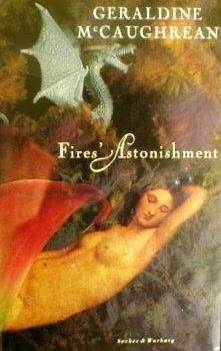
FIRE'S ASTONISHMENT by Geraldine McCaughrean reviewed by Ellen Renner


The Laily Worm

‘I was but seven year auld
When my mither she did dee;
My father married the ae warst woman
The warld did ever see.

‘For she has made me the laily worm,
That lies at the fit o’ the tree,
An, my sister Masery she’s made
The machrel of the sea.’


From the snake in the garden of Eden, via St. George, Theseus and Grendel to Carroll’s Jabberwock, C. S. Lewis’s comical Eustace and Ursula LeGuin’s Earthsea, dragons have been one of storytelling’s favourite devices with which to explore preoccupations about evil, power, the nature of knowledge and the various forms of beastliness lurking beneath our humanity.

There may be some writers who have never wanted to write about a dragon; I am not one of them. I have my own dragon egg incubating, although its hatching date is some years hence. To keep my imagination warm, I like to fuel it with interesting dragon stories. When a friend told me that Geraldine McCaughrean had written a novel for adults about a dragon, and then kindly lent me his copy, it went to the top of my reading pile.

McCaughrean is a writer’s writer. Her prose is elegant, powerful, witty; and this book must surely be amongst her most accomplished. Fire’s Astonishment, published in 1990 by Seeker & Warburg,  was McCaughrean’s second adult novel. It’s a fable, a fairytale – in the best sense of that word – set in a feudal, monk-riddled England. It draws on history, mythology, religion, but most of all, upon McCaughrean’s own gently acid and surgically precise observations about human nature and relationships.

Leo, lord of a small manor near the sea, returns home after a visit to court to find his two adolescent children have disappeared. Their stepmother, the triumphantly pregnant Gywne, recounts the spiritual visitation that led Leo’s son, Elshender, to renounce the world for a monkish life. His daughter, Frideswide, is also missing, reportedly shipped to France as bride to a nobleman.

Now, Leo is a fool – a man more good than bad, but weak and easily led. The reader knows at once that the Welsh-sounding Gywne is to blame; and when rumours arise of a dragon at nearby Worm’s Head, we rightly suspect witchery. The son has been transformed by his stepmother into a beast; and his bethrothed, the dark-haired Elfleda, is shamed and abandoned.

But Gywne’s plan to supplant her husband with her lover and ensure that his bastard child will inherit the manor runs afoul of another simple man – a slightly clever and much better man: Anselm, Leo’s younger brother. Anselm, nearly as large and fleshy as the dragon that was once his nephew, has loved the much younger Elfleda as long as he can remember. If this book has a hero, it is Anselm; if a heroine, Elfleda.

Anselm proposes, and Elfleda accepts with the desperation of the virgin eager to rid herself of her maidenhead and the associated risk of becoming a human sacrifice to the monster dining off the local peasants’ cattle. Poor Elshender, trapped in his beastliness, stalks Elfleda and sends her near witless into his uncle’s arms.

Largely, this is a book about sex. About the beast in all of us; about the human desire to be something more than the sum of our bodily functions. It examines the gross temporalness of our bodies; looks with wit and compassion at the poignancy of our frailty and ugliness – and contrasts the two paths sought as remedy for this earthly, and earthy, state: good and evil.

His man’s rational passion had hankered after Elfleda. Now his unmaterable, mountainous animal heat shackled him to her territory. He marked it, he patrolled it, he held it, and it held him, for a day and a half. When it snowed, the silent cold wiped out all smells and froze the sweat under his scales. The desire in his loins shrank. he thought to set himself on a path away from any place he knew: somewhere empty and open, where hunger would be the only instinct. He rolled wistfully in the snow, his body dissolving into a comfortable numbness and his mind made free to think again. To be a dragon was merely to be seen by human eyes and called a dragon. Away from eyes and away from impulses, Elshender could patrol some empty hinterland, no more loathsome to the things he killed than he had been when he hunted on horseback.

Elshender is a victim, but he is no elegant, heroic youth. Before his transformation, he was a gangling adolescent given to whoring with the local servant girls. His desire for Elfleda is wholly selfish: it is about lust, ownership and status.

One of McCaughrean’s touches of genius in this book is that her dragon presents us with a portrait – in wide screen, high-resolution – of our own human unloveliness and the claustrophobic torment we sometimes feel trapped within our own ungainly flesh:

…Elshender woke up, dreaming of his father, and turned over. The great weight of his body almost crushed the air out of his lungs. He flung his hips back into their first position, and waited for the feeling of panic to subside.

…Elshender the boy had been thin and over-long in the back, his thighs hardly thicker than his calves, his eyes astigmatic and pale, his arms no stronger than he needed to throw dice or whirl the occasional jessy. He loved that inadequate body now: like Narcissus by his pool, he doted on its remembered image. He saw all its virtues, as if through the eyes of an enamoured woman.

Here, Elfleda tries to convince her new husband, Anselm, of the dragon’s existence:

‘Its leg touched me! Then it raised itself up – not in a squat but right up on its back feet. Its belly was the colour of tripe. I could see its lights pumping and bulging through its skin . . . It was such a . . . meaty animal, ‘Selm! I mean – what do I mean? – I suppose I thought the dragon of the Last days would be vaster, or standing in the sky with stars for eyes, you know? It was the difference between the Golden Calf of the Israelites and an ordinary cow standing there in the garden.’

Beyond the elegance and power of the McCaughrean’s prose, the thing that remains with me most strongly upon reading Fire’s Astonishment is the largeness of the characterisation. Not one among the cast of characters, even the most evil, is given less than their due. Portraits are drawn with intelligence and humanity. Each of these characters will stay with you long after the book has been returned to the shelf (or, in my case, its rightful owner).

Find a copy of Fire’s Astonishment; read it. And hope that McCaughrean will give us another adult novel before many more years pass.


Return to REVIEWS HOMEPAGE

Thursday, 3 January 2013

Sparks:A Year in E-Publishing by Authors Electric. Review by Penny Dolan.


Hello. There’ll be a review by Adele Geras along tomorrow, but for the moment, having now read the whole book, here are a few more thoughts on the Sparks anthology I mentioned when opening Awfully Big Reviews for 2013.


The Sparks anthology was created from a selection of posts from the Authors Electric blog, so is, appropriately, an e-book. Now there have been many books created from personal blogs and journalist’s blogs before. Nicola Morgan’s helpful “Want To Be Published?” is just one example.  I am sure there are some by bread-bakers, avid knitters and railway enthusiasts as well as others by people who just lead what could be called Interesting Lives. The Sparks anthology is one example of this phenomenon.

What I most enjoyed about the Sparks anthology was the diversity, which made it ideal for a page-or-two-before-sleep reading or a quick moment during a sandwich. Sparks is not a single voice following through the incidents of a life but a collection of post contributed during the time Authors Electric, a co-operative blog, has been running. The pieces come from writers who work mainly for adult or Y/A/teen readers, so this is not a children’s book.

Excuse me – I still struggle to find indexes and headings on my kindle – but each of the chapters, headed by the famous Blott cartoons, offer a selection of opinions, experiences, histories and reflections on the future of publishing and obviously, the posts come from committed e-book enthusiasts.

Collected together, so one doesn’t have to click or search through the AE blog, the pieces have a fresh, lively and sometimes confrontational quality. The posts – or should they now be called articles? – cover a variety of topics. A well-argued post in support of Amazon. A rightly angry post on cyber-bullying. A post that declares the e-book arena should be home to experimental and un-edited writing but having seen some un-edited writing, I am not sure I agree with this opinion. The tale of a new e-published historical series. An urgent call for e-book writers to be generous and review other e-books. And many more. The anthology is not an amateur thing, though it was clearly made with love and enthusiasm. Sparks was written by many acclaimed and award-winning authors who have opted for publishing o/p titles electronically, with or without help, as an alternative to publishing silence.

The Sparks anthology is not perfect but it should certainly be celebrated as a bold brave and interesting publication model – and a lot of work on several people’s part.

I did wish there could have been more posts, more ideas raised in the pages, but maybe that would have involved the whole issue of selection rather than a post per person – or maybe the posts don’t arrive daily? In addition, some posts still carry the marketing angle of their blog-post origins, but there is a honesty about this, and the final section – the biographies – did have plenty of information about the contributors.

All the same, reading through the variety of experience and wealth of publishing histories, I did wonder once again quite what publishers do want just now and why such writers - just search out the names - are having a hard time. Sparks is a grand and honourable experiment and offers a valuable glimpse of one future of publishing worth exploring.

Recently, I have been using my kindle rather than idly buying magazines – though other magazines are available – and feel that 99p or so was a small sum well spent downloading a very interesting idea. Well done, Authors Electric.

Hmmm. There’s definitely a lot of work involved. Not sure if it would be worth doing this for Awfully Big Blog Adventure, although it is an idea . . .

Penny Dolan


Return to REVIEWS HOMEPAGE

Wednesday, 10 October 2012

The Devil's Staircase by Helen Fitzgerald: reviewed by Gillian Philip


Please note: this review is of an adult novel (officially speaking, but see below).

I came on this book, and this author, not by accident so much as by duty. Scheduled for a panel discussion at the first ever Bloody Scotland crime writing festival - this September in Stirling - I had that sudden, ghastly realisation: that while I already knew and liked @FitzHelen from Twitter, I had somehow failed to read any of her novels. I already knew and loved the work of my other fellow panellist, Cathy MacPhail, but Helen's books, if not Helen herself, were new to me.

Our event was titled Once Upon A Crime and was aimed at discussing Young Adult crime fiction in a festival mostly devoted to the adult variety. Helen's own YA novels, Amelia O'Donohue Is So Not A Virgin and the forthcoming Deviant, are so far only available in the States, so to get to know her writing I chose one of her adult books: The Devil's Staircase.

I wish every duty felt so little like a... duty. Character and voice being my absolute favourite thing/two things in a book, I was delighted (and not a little envious) to be grabbed by the throat on para one page one.

The person doing the grabbing was Bronny, a naive young Australian who runs away to London and the freedom of life in a squat. She has her reasons, and they're not your average needing-to-find-oneself, coming-of-age motives. Indeed, the last thing Bronny wants to find is her self, and the truth of it. Try not being seized and shaken by a girl whose first words to you are these:

"It was fifty-fifty. Mum had it, and died in a pool of her own mad froth."

Oh, Bronny has her demons to escape - in the form of that fifty-fifty chance of a hideous life-threatening disease - and you want her to elude them every bit as much as she does herself. But of course this is a crime novel, with mystery and murder at its heart, and those do not take a back seat. One of the things I liked best about The Devil's Staircase was that although it never lost sight of Bronny's mental torment, it did not gnaw endlessly at it. Bronny is justifiably distracted by her fears, and they contribute to the heartstring-snapping tension of the central plot, but there's something even more sinister under the floorboards - and in the best traditions of the gutsy heroine, Bronny is the one who's going to have to discover it.

We talked a lot at Bloody Scotland about how YA crime fiction differs from the adult version. A young protagonist, the three of us agreed (under the penetrating quizzing of our wonderful chair, Dr Cristina Johnston). We differed a little on whether we'd tone down bad language, violence or sex, but none of us would patronise our readers by 'writing down'. No didactic moral lessons, we also agreed, but maybe a moral heart: a sense that deaths have to matter; that victims be real and mourned and valued as more than plot devices or splatter-fodder (the way it is in the best adult crime fiction, I hastily add; but I for one have read adult fiction where that just ain't so).

But maybe the most important thing, we all reckoned, was a sense of hope at the end. Not a happy ending, necessarily - sometimes anything but - but there has to be at least a way out of violence and misery, a shot at redemption.

The Devil's Staircase qualifies on all counts, as far as I can see, and though it is definitely an adult novel, I wouldn't hesitate to recommend it to a mature older teenager, albeit one with a strong stomach. Bronny's certainly young enough to be a Young Adult heroine, though the horrors that face her are very much of the grown-up world. The victim who takes centre stage in the novel is as important and vivid a character as Bronny herself, and I bit off my favourite nail worrying about her family and her fate (indeed I took to Twitter at one frenetic point to berate her author). As for the ending...

Well, no spoilers. But if you like a psycho-thriller that keeps you reading till the small hours simply because you care desperately what happens - this is one for you.

The Devil's Staircase by Helen Fitzgerald; Polygon 2010

www.gillianphilip.com
www.facebook.com/gillianphilipauthor

Bloody Scotland: Stirling 13th-15th September 2013


Return to REVIEWS HOMEPAGE

Wednesday, 19 September 2012

THE DAMAGE DONE by Linda Newbery. Reviewed by Ann Turnbull


One of the pleasures of train travel is the opportunity to read for long stretches of time.  I recently took my Kindle on a long journey and read this book - one that I'd missed when it was first published in 2001.

I always enjoy Linda Newbery's novels, and this is now one of my favourites.  Although written for teenagers, it's likely to appeal just as much to adults.

Seventeen-year-old Kirsty suffers from night terrors and a fear of crowded places.  She tells lies to her friends and family, inventing imaginary boyfriends and finding excuses for being unable to go out.  Her mother has remarried; her father, a writer, is interested only in his work; and her beloved older brother Jay has gone to America.  Kirsty has failed her exams and refuses to return to studying, despite pressure from her mother.  She prefers to be involved in household tasks and caring for horses.  But the responsibility of running the family home and livery business weighs heavily on her - especially when local people hear of a spate of vicious attacks on horses and the police are known to be looking for suspects.

Kirsty meets Dally, a mysterious and offhand young man employed nearby as a gardener.  Like her, he clearly has family problems, though he will tell her nothing about himself.  She is drawn to him - but can she trust him?

Linda Newbery's writing has a measured quality, and yet she always maintains tension.  Her story unfolds at its own pace, and there is a sense of the seasons, of trees, water and weather, and of the beauty and grace of horses and their natural lives.  Several threads of mystery run through this book, and secrets reveal themselves gradually.  Kirsty makes mistakes, but in the end she comes to a better understanding of herself and others.

This is a story that makes a plea for not forcing either animals or people to conform, but allowing them to take their own way.  I found it a compelling read.

Return to REVIEWS HOMEPAGE

Friday, 17 August 2012

Wolf Hall and Bring Out The Bodies by Hilary Mantel, reviewed by Susan Price


'Wolf Hall' by Hilary Mantel
          Wolf Hall’ and 'Bring Up The Bodies', by Hilary Mantel hardly need my tin whistle to pipe their praise; but I’m going to toot anyway - and at greater than usual length - because there are no other books I want to praise so much.
          I downloaded Wolf Hall to my kindle at the end of May, and there it sat, until the end of July.  I’d heard rumours that it was good, but, well – it was about Tudor politics and Anne Boleyn.  I’d been there before.  Besides, wasn’t it written in the present tense?  I’d read other things in that tense and been dismayed by their clumsiness.
          But from the moment I started Wolf Hall, I was away with Thomas Cromwell.
          Now, I’m a hardened reader.  This makes me difficult to please.  I realise that most of the time I read with a commentary going on at the back of my mind: ‘I’d change that word; I’d cut that; I’d rewrite that sentence; I don’t think that character would do that…’
          I realise this because, while I engulfed Wolf Hall, this commentary was silent.  Mantel’s writing is effortless, beautiful, expert.  I questioned nothing.
          I experienced that pleasure which is quite rare for me these days – the hankering for a book and its world.  I was always eager to get back to it.  I often clicked back a few pages to read a passage again, simply because it was so beautiful. When I saw from the bar at the bottom of the kindle page that the end was close, I rationed my reading, to make it last.
          The moment I finished Wolf Hall, I clicked through to the kindle store and downloaded Bring Up The Bodies.  It was every bit as good.
          We are promised a third book – at the end of which Cromwell, presumably, will get it in the neck.  I bite my nails.  Why didn’t I wait until the third was published, and then I could have read all of them, one after another?
Thomas Cromwell
          When I think of Mantel’s achievement with these books, I am awed.  First, the research.  I faint in coils at the thought of the reading necessary to amass such detail of social manners, clothing, furnishing, politics, religious schisms, climate, and the hullaballoo of daily life in the early 1500s.
          But then, to pluck from all that only the few details she needs: and nothing more.
          A biography would have taken no more research – and Mantel goes beyond that.  She fictionalises it all: which means she dresses in the facts, goes inside them and recreates Cromwell from the inside – and every scene he takes part in.  Henry VIII, Anne Boleyn, Thomas Moore, Cramner – we see, hear and understand all of them as Thomas Cromwell sees, hears and understands them.  We see the countryside, feel its cold and damp, its warm summer days.  We smell the stinks of the streets, the perfume of spices, we witness executions… It is all completely convincing and absorbing, and the amount of thought, concentration, imagining, rewriting and sheer hard work this represents is heroic.
          But more still.  The prose is beautiful.  Its cadences slide through your mind like silk, until some sharp point purposely sticks you like a hidden needle.  Words are worked.  Why is the book called Wolf Hall? Because the family seat of Jane Seymour is called ‘Wolf Hall.’   Not a single scene is set there, but we are directed, ironically, to Anne Boleyn’s downfall even at the time of her greatest triumph.
          Also, men are wolves to men’, and these aristocrats, within whose orbit Cromwell finds himself, are those very wolves: murdering for their own political advantage and selling their daughters.
          Bring Up The Bodies famously opens with Cromwell hunting, with birds named after his own, dead, daughters.  His children are falling from the sky… each with a blood-filled gaze… Her breast is gore-streaked and flesh clings to her claws…These dead women, their bones long sunk in London clay, are now transmigrated.  Weightless, they glide on the upper currents of the air.  They pity no one… When they look down they see nothing but their prey… they see a flittering, flinching universe, a universe filled with their dinner.’
          This reminds us of the family Cromwell mourns: but is also the world-view of the people for whom he works.  It is possibly the view of Cromwell himself.  It’s even, possibly, the view of the dead, and of God, who has gathered them to Himself.  (And although I have severely trimmed the above quote, the beauty of the prose, its lovely rhythms, survives.)
          The book is far from what I half-feared: another trot through Tudor history, as made familiar by many romantic novels and television series. This Anne Boleyn is no romantic heroine, no damsel in distress: she is sharp as a knife, intelligent, relentlessly calculating and self-interested.  After all, look at the family she came from and her upbringing. 
'Bring Up The Bodies' by Hilary Mantel
          Her brother, George, is a spoiled, self-regarding, nasty little ****.  Mantel even suggests that the incest charge may not have been the trumpery most accounts assume it was.  Anne and George Boleyn were reared apart, hardly meeting before adulthood, and siblings today who meet only as adults often feel a powerful erotic attraction.  And Anne was desperate for a son, the only thing that would maintain her position, while George was desperate to maintain his position as the king's brother-in-law.
          Mantel’s Thomas Moore is not saintly, but a vain, self-centred man who makes a pet of one daughter, while routinely insulting the others and his wife.  His urbane manner masks a furious hatred of anyone who dares to understand God other than as Moore does.  The only good Protestant is a dead, burned one.
          It's Cromwell who is usually portrayed as ruthless and brutal, even if intelligent and talented.  Mantel makes him a humorous, compassionate man, whose wide-ranging life and enquiring intelligence have given him vast experience and knowledge, together with a sharp insight into the nature and motives of others.  This enables him to outplay them in the Tudor court’s lethal political chess games.
          His violent, neglectful childhood has made him sympathetic to the poor and abandoned.  Large numbers of the poor are fed from his kitchens every day while his house is full of orphans and apprentices, who flourish in his care.  Mantel gives him a dry, dead-pan wit, and makes him loveable.
          He is also ruthless, when required, and vengeful.  He sees himself as a man who has a job to do, with the tools available.  Politics as the art of the possible.
          But if he can spare somebody’s life, he will; and he considers that, despite his deep dislike of the man, he gave Moore every chance to evade the death sentence.  It was Moore’s own obstinate insistence on being right that saw him executed.
           If it’s not possible to do the job without a death, then Cromwell will ensure that the scaffold is erected in time and the straw spread to soak up the blood, before returning to his loving household and dogs.
          Is this a truthful representation of Cromwell, or of the other historical personages?  Who knows?  Mantel herself says that she offers her books as one possible interpretation of the facts.  The books read almost as an illustration of the truth that we can never fully understand other people.  We can observe what they do, and what they say, but when we try to deduce, from these observations, their thoughts and emotions, all we can do is make an interpretation, filtered through our own emotions, thoughts and experience.  It may be accurate, or wildly inaccurate, but we will never know which.
          And people change.  It may be that the books offer Cromwell’s own interpretation of himself – a good guy really, despite all he’s done.  We all put the best possible spin on ourselves.  I think there are hints, towards the end of Bring Up The Bodies that Cromwell’s good-guy self-image is faltering – another reason why I look forward keenly to the third book.
          I read one review of Wolf Hall which began, ‘I hesitate to use the word ‘masterpiece’…’
          Well, I refuse to use the word, ‘masterpiece.’  These books are by a Mistress: in short, works in which the greatest powers of the mind are displayed, in which the most thorough knowledge of human nature, the happiest delineation of its varieties, the liveliest effusions of wit and humour, are conveyed to the world in the best-chosen language."
____________________________________________________

Susan Price
Susan Price is the award winning author of 'The Ghost Drum' and 'The Sterkarm Handshake.'

Her website is here
Her blog can be found here
She is also a member of the Authors Electric blog.


Return to REVIEWS HOMEPAGE